 Debtless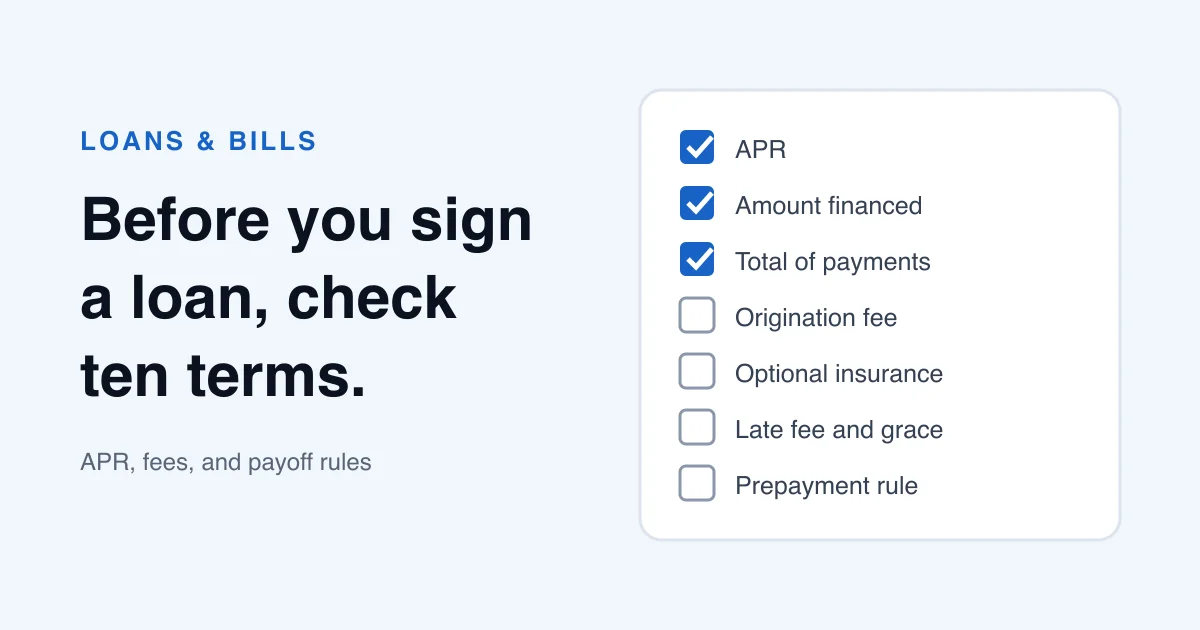
The short answer
Before you sign a loan, check the APR, the amount you actually receive, the total you will repay, every fee, and what happens if a payment is late or you pay the loan off early. The Truth in Lending Act requires lenders to disclose the APR and other key terms, and the Consumer Financial Protection Bureau (CFPB) defines the APR as the interest rate plus additional fees. Use the checklist below to compare offers on those numbers, rather than on the monthly payment alone.
Why does the APR matter more than the interest rate?
The interest rate is what the lender charges for the money you borrow. The APR adds the fees on top, so two offers with the same rate can cost different amounts. The CFPB says the APR is the interest rate plus any additional fees charged by the lender, and it notes that the federal Truth in Lending Act requires lenders to give you specific disclosures about the important terms of a loan, including the APR.
That disclosure is the document to read before you commit. Ask for it in writing before you accept an offer, and read it on its own, away from the sales conversation.
Which terms should you check on every offer?
Work through the table in order. Each row is a number or clause you should be able to find in the lender's disclosure or loan agreement. If you cannot find one, ask for it in writing before you go further.
| Term | What to write down | Why it matters |
|---|---|---|
| Amount financed | Cash you actually receive after fees | The base for every calculation that follows |
| APR | The yearly cost, including fees | Lets you compare offers that look different |
| Finance charge | Total dollars of interest and fees | Shows the cost in dollars, alongside the percentage |
| Total of payments | Every payment added together | The full repayment you are agreeing to |
| Payment and schedule | Amount, number of payments and due dates | Confirms the monthly figure fits your budget |
| Origination fee | Charge for setting up the loan | The CFPB lists it among common personal loan fees |
| Documentation fee | Charge for processing the paperwork | A separate line that is easy to miss |
| Optional insurance | Credit or disability insurance | The CFPB describes these as generally optional |
| Late fee and grace period | Amount charged and days before it applies | Sets the cost of one missed due date |
| Prepayment and collateral | Any early payoff charge, and what secures the loan | Affects both early payoff and default |
Items follow the CFPB's list of personal installment loan fees. Your lender's documents control.
How do you judge a rate against a benchmark?
A rate means little without a reference point. The Federal Reserve's G.19 consumer credit release, dated September 8, 2026, reports that the average interest rate on 24-month personal loans at commercial banks was 11.86% in the second quarter of 2026, up from 11.50% a year earlier. That average covers borrowers across the credit range, so treat it as a rough reference point and expect your own offer to differ.
If an offer's APR sits well above that line, ask what drives the difference: a weaker credit profile, a fee, or a shorter term. What a Bad-Credit Loan Actually Costs shows how a higher APR changes the dollars on a real balance.
What do the late-payment and early-payoff clauses change?
A loan that looks cheap can get expensive in two situations: a missed payment and an early payoff. Find the late fee and the grace period, which is the number of days after the due date before the fee applies. Then find the prepayment clause. Some loans carry no charge for paying early and some carry a fee, so the clause decides whether an extra payment saves interest or costs you money.
Ask how an extra payment is applied. The lender should be able to say in writing whether it reduces principal right away or is held until the next due date. If the loan is a car loan, paying it off early has a separate credit effect, which Does Paying Off a Car Loan Early Hurt Your Credit? explains.
Does a secured loan add terms to check?
Yes. A secured loan uses an asset, such as a savings account or a vehicle, as collateral. Collateral can lower a rate, and it can come with its own charges. The CFPB lists non-filing insurance as a possible charge when a loan is secured by collateral. Read what the lender can take if you default, and read which fees come with the collateral.
Once the terms check out, How to Pick a Personal Loan Lender covers comparing lenders on their total offer.
Worked example · illustrative numbers
Example: a $10,000 loan with a $500 origination fee
Suppose an offer gives you $10,000 for 36 months at a 12% interest rate, and the lender takes a $500 origination fee out of the loan before the money reaches you. You receive $9,500, but you repay on the $10,000 schedule.
On $10,000 at 12% over 36 months, the monthly payment is $332.14. Thirty-six payments total about $11,957. Subtract the $9,500 you received and the finance charge is about $2,457. The rate that makes those payments repay the $9,500 works out to an APR of 15.61%, which is above the 12% rate printed on the offer.
The same loan with no fee would have a finance charge of about $1,957 and an APR of 12%. The $500 fee accounts for the gap of about 3.6 percentage points, and it is the cost a rate-only comparison would miss.
This is a hypothetical example. Lender terms and the actual disclosure can differ.
Put this into practice with Debtless
Debtless is a free iPhone app with no subscription, ads or bank linking. You can enter each loan's balance, APR, minimum payment and due date by hand, and the Plan tab shows how that loan ranks against your other debts. It is a tracker, not a contract reviewer, so the disclosure stays your job.

Common questions
Is the APR always higher than the interest rate?
Usually it is higher when there are fees, and it matches the rate when there are none. The APR is the interest rate plus additional fees, so it captures the cost the rate leaves out.
Can I ask a lender to remove an optional add-on?
Often, yes. The CFPB describes credit insurance and disability insurance as generally optional. Ask for the offer with and without them, and compare both the APR and the finance charge.
Does a higher APR always mean a worse loan?
No. A shorter loan can carry a higher APR and still cost fewer dollars than a longer loan at a lower APR. Compare the finance charge in dollars alongside the APR, then check the payment against your monthly budget.
What if the lender will not show the disclosure before I sign?
Do not sign yet. The Truth in Lending Act requires the disclosure, so ask for it in writing and read it before you accept anything.
Sources & further reading
- Federal Reserve Board - Consumer Credit - G.19
- CFPB: What is the difference between a loan interest rate and the APR?
- CFPB: Personal installment loan fees
General education for U.S. readers, not individualized financial, legal or tax advice. Examples are hypothetical; lender terms and actual interest calculations can differ. Check your current statements and agreements.
Published by Debtless with AI-assisted drafting. How this journal is made · Suggest a correction