 Debtless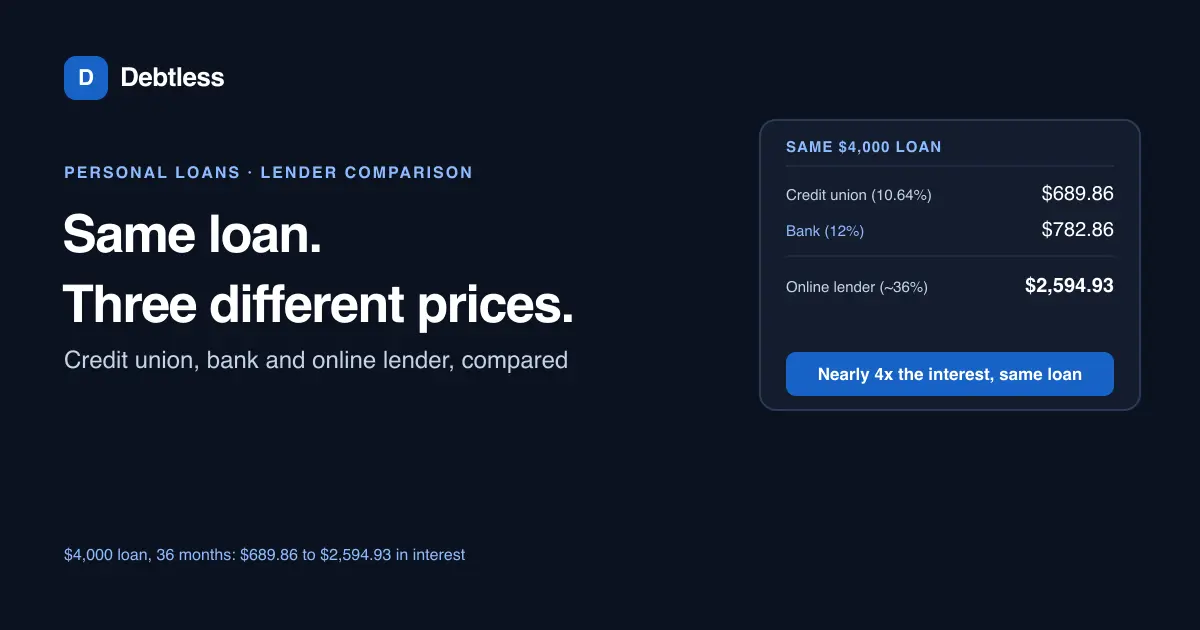
The short answer
Picking a personal loan lender means comparing more than the quoted rate: Bankrate's own data shows credit unions averaging 10.64% APR, banks around 12%, and online lenders ranging from under 6% to almost 36% depending on credit. The right fit depends on whether you qualify for a credit union's membership, how fast you need the money, and whether you have savings to secure the loan against for an even lower rate.
Bank, credit union, or online lender: what's actually different?
Bankrate's own rate data puts the national average for a three-year personal loan at a credit union at 10.64%, against roughly 12% at a traditional bank and a much wider spread online, from under 6% for the strongest applicants to almost 36% for the weakest. Credit unions also carry a legal ceiling: federal credit unions can't charge more than 18% on most loans, a cap the NCUA board voted to extend through September 10, 2027.
Membership is the real gate at a credit union, since you typically need to join, sometimes for a small fee, before you can apply. Bank Loan Payment Calculator: Common Mistakes covers a separate mistake that applies at any of the three: entering the amount you want instead of what you'll actually be charged once a fee gets added.
Should you secure the loan against your own savings?
A savings-secured, or certificate-secured, loan uses money you already have as collateral instead of your credit score, which is why it carries the lowest rate on this list. Navy Federal Credit Union, for one, prices its certificate-secured loan at the certificate's own rate plus 2 percentage points, and publishes a worked example of a $3,000 loan against a 7-year certificate paying 4.20% APY coming out to a 6.20% APR and a $59 monthly payment over 60 months.
The trade-off is access: the pledged savings or certificate stays locked up until the loan is paid off, so this only works if the cash is already sitting there and doesn't need to stay liquid in the meantime.
How much will fees actually add to the loan?
An origination fee is charged to cover the cost of issuing the loan, and Bankrate's data puts the typical range at 1% to 10% of the loan amount, with some bad-credit lenders charging up to 12%. Most lenders deduct it from what you receive rather than billing it separately, so a $10,000 loan with a 5% fee actually puts $9,500 in your account while you still owe interest on the full $10,000.
Amortization Repayment Calculator: Loan Types Compared covers how that gap between what you borrow and what you receive plays out across different loan structures, which matters more the smaller the loan amount is.
How do you compare two offers that look different?
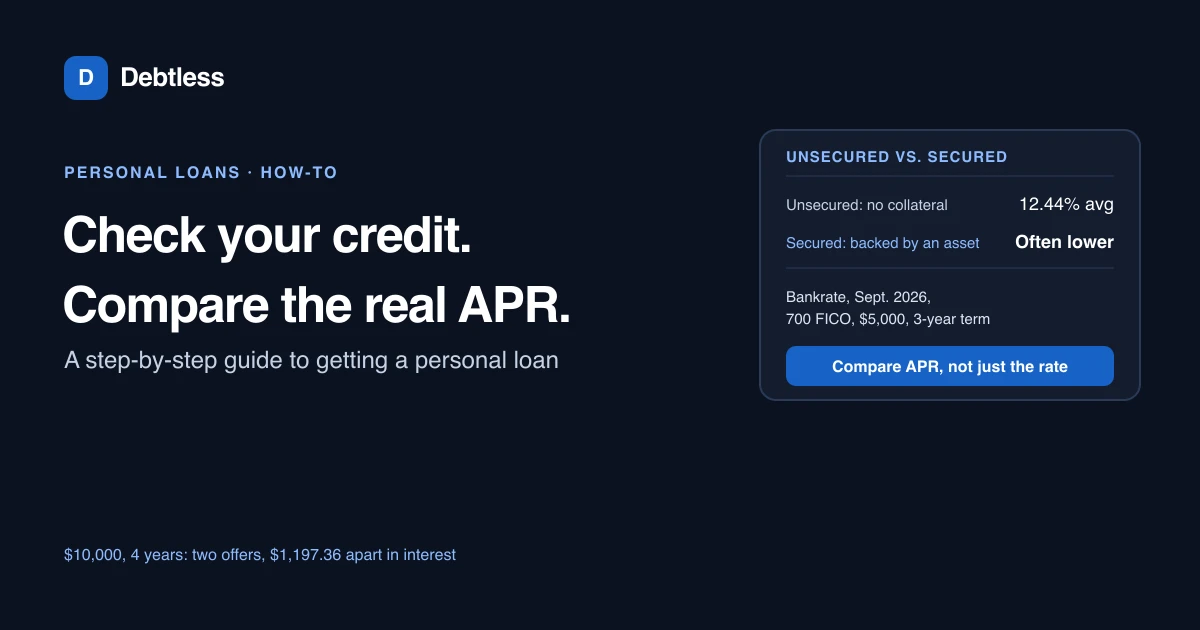
The interest rate alone doesn't tell you the full cost; the CFPB defines APR as the rate that reflects interest and fees together over a year, which is why lenders are required to disclose it before you sign. Two loans quoting the same interest rate can carry different APRs once origination fees get added in.
Line up the APR, not the advertised rate, for every offer before deciding, and run the same loan amount and term through each one. Debt Management Plan vs. Consolidation Loan is worth checking too if a personal loan turns out to be the wrong tool entirely, since a plan negotiated by a nonprofit agency sometimes beats any rate a lender will quote.
Where to look for a personal loan, compared
| Lender type | Typical APR | Best fit |
|---|---|---|
| Credit union | 10.64% national average; capped at 18% by federal rule | Best rate if you qualify for membership |
| Bank | Around 12% on average | An existing relationship can speed approval |
| Online lender | Under 6% to almost 36%, depending on credit | Fastest funding; widest range for weaker credit |
| Savings-secured | Your savings or certificate rate, plus about 2 points | Lowest rate, if the savings can stay untouched |
Rates per Bankrate's average personal loan interest rate data and Navy Federal Credit Union's published certificate-secured loan terms.
Worked example · illustrative numbers
Example: a $4,000 loan, three ways
Run the same $4,000 loan through three lenders over 36 months. At a credit union's 10.64% average, the payment is $130.27 a month and $689.86 in total interest. At a bank's 12% average, it's $132.86 a month and $782.86 in interest, close enough that an existing relationship or faster approval could tip the decision either way.
At an online lender near Bankrate's reported high end of almost 36%, the same $4,000 costs $183.19 a month and $2,594.93 in interest, nearly four times the credit union's cost for borrowing the identical amount. The lender type matters as much as the credit score walking in.
Put this into practice with Debtless
Whichever lender you pick, Debtless tracks the loan by its real balance, rate and term the same way it tracks every other debt, so you can see its payoff date next to your cards and everything else in the free iPhone app's payoff calculator.

Common questions
Is a credit union loan always cheaper than a bank loan?
Usually, but not guaranteed. Bankrate's data shows a national average of 10.64% at credit unions against about 12% at banks, a gap worth roughly $93 in interest on a $4,000, 36-month loan, though an individual offer can land anywhere depending on credit and membership history.
What's the catch with a savings-secured loan?
The pledged savings or certificate stays locked up until the loan is paid off in full. Navy Federal's version, for example, prices the loan at the certificate rate plus 2 percentage points, far below an unsecured rate, but only works if that money can stay untouched.
How much do origination fees actually cost?
Bankrate puts the typical range at 1% to 10% of the loan amount, with some bad-credit lenders charging up to 12%. Most lenders subtract it from what you receive, so you're paying interest on more than what actually lands in your account.
Why do two loans with the same interest rate cost different amounts?
Because the interest rate alone doesn't include fees. The CFPB requires lenders to disclose APR, which folds in the origination fee and any other finance charges, and that's the number that actually makes two offers comparable.
Sources & further reading
- Bankrate: Average Personal Loan Interest Rates
- Bankrate: Personal Loan Origination Fees
- Navy Federal Credit Union: Certificate Secured Loan
- NCUA: Board Extends Loan Interest Rate Ceiling
- CFPB: What is an annual percentage rate (APR)?
General education for U.S. readers, not individualized financial, legal or tax advice. Examples are hypothetical; lender terms and actual interest calculations can differ. Check your current statements and agreements.
Published by Debtless with AI-assisted drafting. How this journal is made · Suggest a correction