 Debtless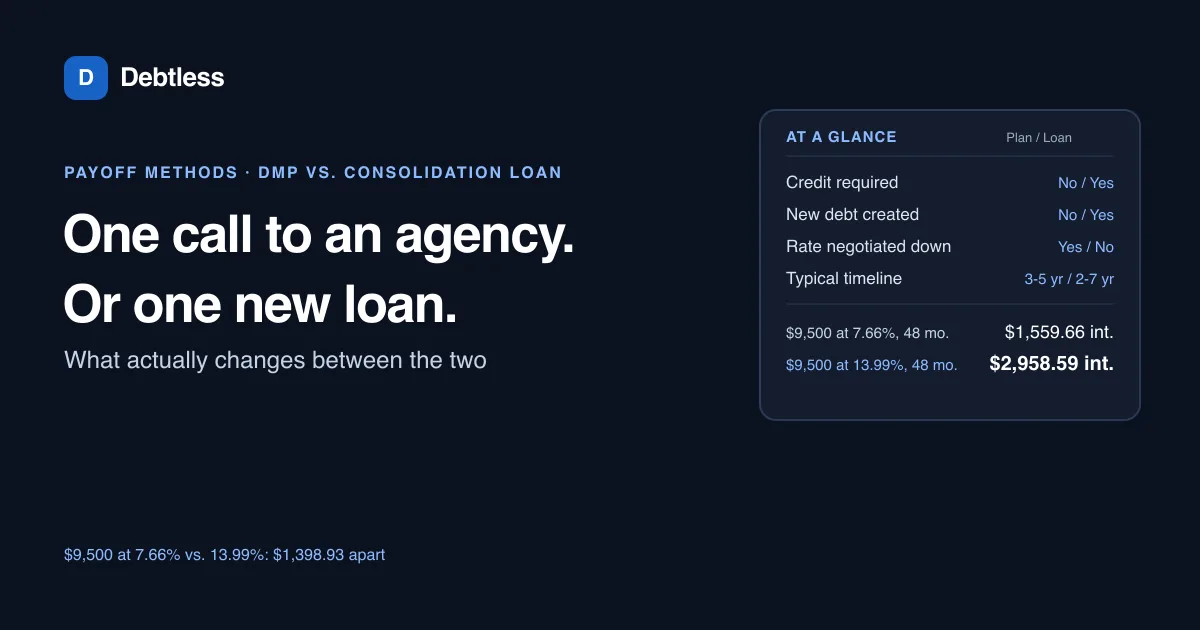
The short answer
A debt management plan enrolls your existing cards with a nonprofit credit counseling agency, which negotiates a lower rate with your issuers and collects one monthly payment to distribute, typically over three to five years, according to the National Foundation for Credit Counseling. A debt consolidation loan is a brand-new loan that pays off your old balances and replaces them with a single installment payment, and it generally needs good credit to get a rate worth taking. Neither erases what you owe; they change how you pay it off, and which one fits depends mostly on your credit and how close you already are to approval.
What actually happens to your accounts in each one?
A debt management plan leaves your underlying accounts open but typically closed to new charges once you enroll, since the agency is negotiating directly with the issuers that already hold your debt. No new credit line gets opened and no new application gets run, which is why a plan is available regardless of your credit score.
A debt consolidation loan does the opposite: it opens a brand-new account, uses the loan proceeds to pay off your old balances, and leaves you with one installment loan at a rate the lender set based on your credit. The old accounts usually show as paid off rather than closed by you, but the new loan is a new line on your report that didn't exist before.
Does either one require good credit?
A debt management plan does not screen for credit at enrollment; nonprofit credit counseling agencies work with whatever score you bring, which is part of why it's often recommended once a score has already dropped into the low 600s or below.
A consolidation loan is priced on credit the way any other loan is. Bankrate's own interest-rate statistics put the average five-year personal loan rate at 13.99% for borrowers with a 700-to-759 score, versus 24.99% for borrowers scoring 620 to 639, so a consolidation loan can still get approved with weaker credit, just rarely at a rate that beats the cards it's replacing.
How long does each one actually take?
A debt management plan runs on a schedule the agency and your issuers agree to, and the NFCC describes most plans finishing within three to five years once a negotiated rate and fixed monthly payment are in place.
A consolidation loan has a fixed term chosen at signing, commonly two to seven years, and that term is the whole payoff timeline unless you pay it off early. What matters is whether the new rate actually beats the blended rate on what it's replacing; How to check whether a consolidation loan saves money walks through comparing total cost instead of the monthly payment alone.
What does each one do to your credit along the way?
Enrolling in a debt management plan can cause a small, temporary dip, since closing accounts to new charges pushes your credit utilization toward 100% on paper even while you're paying the balance down. myFICO describes that dip as usually lasting the first eight to ten months before scores begin climbing again as on-time payments build up, and finishing a plan can add 100 points or more by the end.
A consolidation loan adds a new account, which briefly touches your credit mix and average account age, then helps your score as the old revolving balances show as paid and the new loan reports on-time payments. Both options assume a steady amount lands every month; Variable income debt payments: use a base-and-extra plan covers a way to handle either one when your paychecks don't.
What if neither one fits?
Both options exist because building a plan yourself takes more effort to set up than enrolling in either one. How to make a debt payoff plan from your statements covers doing that with no agency fee and no new loan, and it's worth comparing against both options above before committing to either.
The three aren't mutually exclusive. Someone can call their own issuers for a rate cut first, fall back to a debt management plan if that fails, and still compare the total cost against a consolidation loan before signing anything; Debt consolidation vs. a payoff plan: what changes? covers the tradeoff between a loan and managing the payoff yourself in more detail.
Debt management plan vs. debt consolidation loan
| Debt management plan | Debt consolidation loan | |
|---|---|---|
| Credit required | None; available at any score | Good credit for a rate worth taking (13.99% avg. at 700-759 FICO vs. 24.99% at 620-639, per Bankrate) |
| New debt created | No; existing accounts stay open, typically closed to new charges | Yes; a new installment loan replaces the old balances |
| Interest negotiated down | Often yes, by the agency directly with your issuers | No; you're quoted a new market rate based on your credit |
| Typical timeline | 3 to 5 years, per the NFCC (MMI reports a 50-month average) | 2 to 7 years, fixed at signing |
| Credit score path | Small dip for roughly 8-10 months, then recovery, per myFICO | Short-term dip from the new account, then recovery as it reports on time |
Credit figures per Bankrate's personal loan interest-rate statistics; timeline and score path per the NFCC, Money Management International and myFICO.
Worked example · illustrative numbers
Example: $9,500 across three cards, two ways
Take a hypothetical $9,500 spread across three cards, each charging somewhere near the 22.15% average the Federal Reserve reported for card accounts assessed interest in the second quarter of 2026. Enrolled in a debt management plan at 7.66%, the average rate Money Management International reported across its enrolled accounts in 2025, the balance clears in 48 months at $230.41 a month, with $1,559.66 in total interest.
The same $9,500 rolled into a consolidation loan at 13.99%, Bankrate's average for a borrower with a 700-to-759 credit score, on the same 48-month term costs $259.55 a month and $2,958.59 in total interest, about $1,398.93 more than the plan in this scenario, because the negotiated rate undercuts what even good credit gets priced at on a new loan.
Put this into practice with Debtless
Debtless tracks whichever path you choose, a negotiated-rate plan or a new consolidation loan, the same way it tracks every other debt: by balance, rate and term, so you can see the payoff date next to every other method in the free iPhone app's payoff calculator.

Common questions
Is a debt management plan worth it if I have decent credit?
It can still make sense if the rate an agency negotiates comes in lower than any loan you'd qualify for, which is common on credit card debt specifically. It's worth asking a nonprofit credit counseling agency what rate they expect before ruling it out just because your credit would also qualify for a loan.
Does a debt consolidation loan hurt your credit?
It can cause a brief dip from the new account and the credit check required to apply, but it typically helps within a few months as the old revolving balances report as paid off and the new loan builds on-time payment history.
How long does a debt management plan take to pay off my debt?
Most run three to five years, according to the National Foundation for Credit Counseling, depending on your balance, what you can afford monthly, and the rate your agency negotiates with each issuer.
What credit score do I need for a debt consolidation loan?
There's no universal cutoff, but Bankrate's data shows the best rates going to borrowers around 700 or higher. Lower scores can still qualify, typically at a rate closer to what the cards being replaced already charge.
Can I use both a debt management plan and a consolidation loan?
Not at the same time on the same debt. Some people use a consolidation loan for part of their balances and leave the rest on a payment plan, but most agencies expect enrolled accounts to stay on the plan until they're paid off.
Sources & further reading
- NFCC: Which Debt Repayment Method Is Right for You?
- myFICO: How a Debt Management Plan Can Impact Your FICO Scores
- Bankrate: Personal Loan Interest Rate Statistics
- Federal Reserve: Consumer Credit G.19, credit card interest rates
- Money Management International: How Much Can You Save with a Debt Management Plan?
General education for U.S. readers, not individualized financial, legal or tax advice. Examples are hypothetical; lender terms and actual interest calculations can differ. Check your current statements and agreements.
Published by Debtless with AI-assisted drafting. How this journal is made · Suggest a correction