 Debtless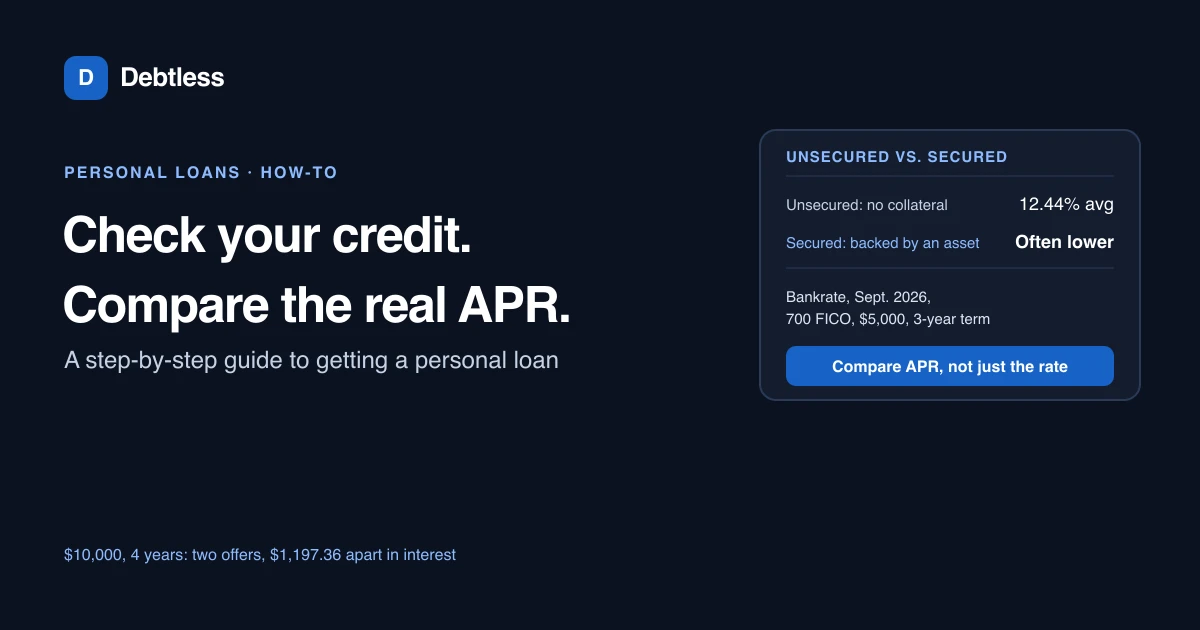
The short answer
A personal loan is a fixed amount you borrow from a bank, credit union or online lender and repay in equal monthly installments, usually over two to seven years. To get one, you check your credit standing, compare real APR quotes from more than one lender rather than an advertised teaser rate, and confirm the origination fee and term before signing, since both change what you actually owe each month. As of September 16, 2026, Bankrate reported an average personal loan rate of 12.44% for a borrower with a 700 FICO score, with offers across lenders ranging from about 6% to nearly 36% depending on credit.
Check where you stand before you apply
Your credit standing decides which loans you'll actually qualify for and what rate you'll pay on them. A good FICO Score is generally considered 670 or higher, according to Bankrate, and lenders offering unsecured personal loans typically reserve their best rates for borrowers in that range or above with steady income.
If your score is below that range, an unsecured loan isn't necessarily off the table, but the rate offered will usually sit well above the average, and some lenders may decline the application outright. Knowing where you stand before you apply saves you from a round of hard inquiries on offers you were never likely to get.
Secured or unsecured changes almost everything else
An unsecured personal loan doesn't require collateral; the lender is relying on your credit and income alone, which is why it typically carries a higher rate. A secured personal loan backs the loan with an asset, savings, a vehicle or something similar, and because the lender has that asset to fall back on, it can often offer a lower rate or approve a larger amount, with the trade-off that you can lose the asset if you default.
Most people shopping for a personal loan are looking at the unsecured version, since it doesn't tie up an asset, but it's worth asking any lender you're considering whether a secured option is available if the unsecured rate you're quoted looks high relative to your credit.
Compare APR, not the interest rate on its own
According to the CFPB, the interest rate is simply the cost of borrowing the money, while the APR adds in the origination fee and other charges the lender assesses when the loan is issued. Two loans with the same interest rate can carry different APRs once one lender's fee is factored in, which is why the CFPB advises comparing APR to APR across lenders, not an interest rate from one quote to an APR from another.
How to Record a Personal Loan Origination Fee covers how that fee actually reduces the amount that reaches your account, even though you owe interest on the full amount financed, including the fee itself.
Watch for offers that skip the credit check entirely
A legitimate lender reviews your credit history and application before deciding whether to approve you; that step is unavoidable. According to the FTC, offers built around phrases like "bad credit, no problem" or a guarantee of approval before any review are a common setup for an advance-fee loan scam, where you're asked to pay a processing or insurance fee upfront and the loan never actually arrives.
The FTC's core rule of thumb applies here directly: no legitimate lender asks you to pay for a promise. If a loan is real, any fees come out of the loan proceeds or your first payment, not a wire transfer before you've received anything.
Secured vs. unsecured personal loans
| Unsecured | Secured | |
|---|---|---|
| Collateral required | None | Yes, savings, a vehicle or another asset |
| Typical credit needed | Good to excellent, generally 670+ FICO for the better offers | More flexible, since the asset backs the loan |
| Typical rate | Higher, since the lender has no asset to recover | Often lower, but you risk losing the asset if you default |
| Bankrate average, Sept. 2026, 700 FICO / $5,000 / 3-year term | 12.44% | Varies by lender and collateral |
Credit guidance and averages per Bankrate's Personal Loan Rates and Secured vs. Unsecured Personal Loans coverage, September 2026.
Worked example · illustrative numbers
Example: two offers for the same $10,000, 4-year loan
Say you're comparing two real offers on a hypothetical $10,000 loan over 48 months. The first quotes 10.99% APR, working out to a monthly payment of $258.41 and total interest of $2,403.52 over the life of the loan. The second quotes 15.99% APR on the same amount and term, a payment of $283.35 and total interest of $3,600.88.
The two offers look close on a monthly basis, about $25 apart, but that gap compounds to $1,197.36 more in interest on the second loan by the time it's paid off. Getting quotes from more than one lender before signing is what surfaces a gap like that in the first place.
Put this into practice with Debtless
Once a personal loan is funded, Debtless lets you enter the balance, rate and term directly with no bank connection required, the same manual-entry approach How to Track an Auto Loan Without Linking Your Bank describes for a car loan, so it shows up on the same payoff timeline as every other debt in the free iPhone app.

Common questions
What credit score do I need for a personal loan?
There's no single cutoff, but a FICO Score of 670 or higher, considered good credit by Bankrate's standard, generally qualifies you for the better unsecured rates. Lower scores can still qualify, usually at a higher rate or through a secured loan.
Is a personal loan the same as a payday loan?
No. A personal loan is a fixed-term installment loan with regular monthly payments, typically over one to seven years. A payday loan is a short-term, small-dollar loan usually due in full on your next payday, with different terms and much higher typical costs.
Why did two lenders quote me different APRs for the same rate?
APR includes the interest rate plus fees like an origination charge, so two loans with an identical interest rate can carry different APRs if their fees differ. Compare the APR figures directly, not the interest rate alone.
How do I know if a loan offer is a scam?
Be cautious of any offer that guarantees approval before checking your credit, or that asks for a fee upfront before you've received the loan. The FTC treats both as common warning signs of an advance-fee loan scam.
Sources & further reading
- Bankrate: Average Personal Loan Interest Rates
- Bankrate: Secured vs. Unsecured Personal Loans
- CFPB: What is the difference between a loan interest rate and the APR?
- FTC: What To Know About Advance-Fee Loans
General education for U.S. readers, not individualized financial, legal or tax advice. Examples are hypothetical; lender terms and actual interest calculations can differ. Check your current statements and agreements.
Published by Debtless with AI-assisted drafting. How this journal is made · Suggest a correction