 Debtless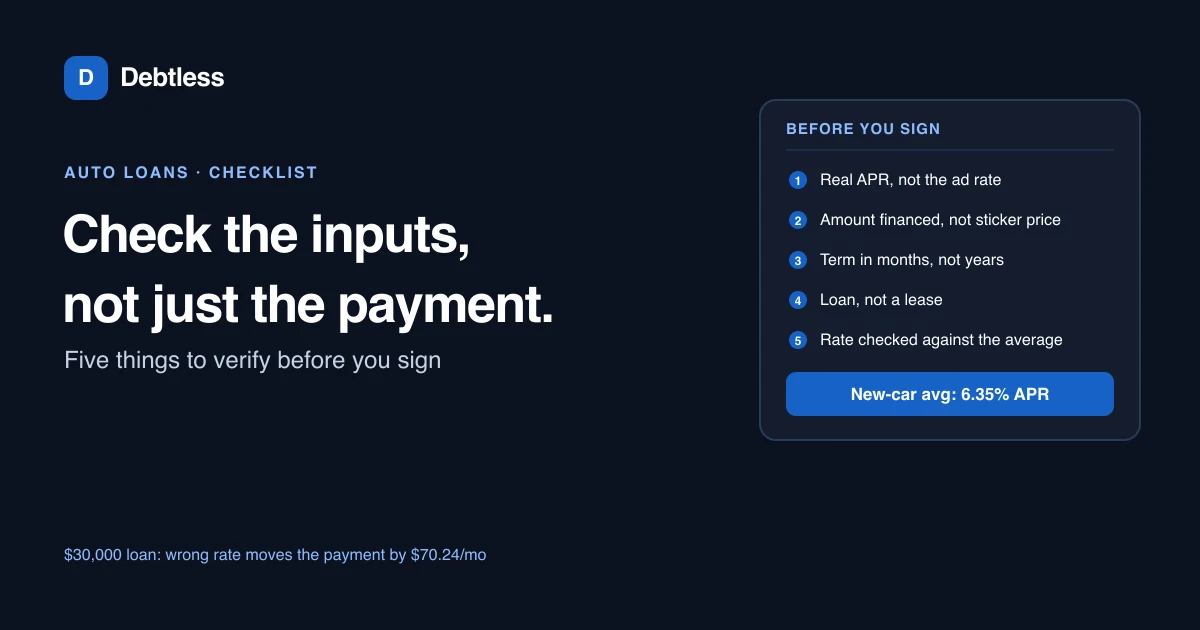
The short answer
A car payment calculator turns three numbers into one fixed monthly payment: the amount you're financing, your APR, and the loan term in months, run through the same formula a lender uses. That number is only as good as what you type in, and a dealer's paperwork doesn't always hand you those three figures in a form you can drop straight into a calculator. On a $30,000 loan, mixing up just the interest rate can move the monthly payment by more than $70.
The math is fixed. The inputs usually aren't.
A car payment calculator, including the one built into Debtless, doesn't guess at your payment. It runs the amount financed, the APR, and the term through the standard amortization formula, the same one a bank uses to set up your note. Feed it the same three numbers and every calculator built this way spits out the same payment, down to the cent.
Where things actually go wrong is almost never the math. It's the inputs. A dealer quote can bundle in an add-on you never noticed, a rate sheet can list a promotional rate you don't actually qualify for, and a loan application can ask for the term in years while the calculator wants months. According to the Consumer Financial Protection Bureau, interest on an auto loan is charged on the outstanding balance each month, so a mistake in any one of the three inputs doesn't just skew one payment. It skews all of them.
Five things to check before you type anything in
Run through these before you trust a payment estimate enough to sign around it.
- Confirm the rate on your paperwork is the APR you were actually approved for, not an advertised "as low as" rate that only applies to buyers with top-tier credit.
- Enter the amount financed, not the sticker price: the price minus your down payment and any trade-in, plus tax, title and whatever the dealer rolled into the loan.
- Match the term to what's printed on the contract in months. A calculator that receives "5" instead of "60" will return a payment with no relationship to reality.
- Check whether the number in front of you is a loan or a lease. Lease payments run on a money factor and a residual value, not a fully amortizing balance, so a loan calculator will misprice one.
- Compare the rate you were quoted against the current average for your vehicle type. If your credit is strong and the number is far from that average, it's worth asking why before you sign.
What the averages look like right now
According to Experian's State of the Automotive Finance Market report, the average interest rate on a new-car loan was 6.35% in the second quarter of 2026, while the average used-car rate was 11.19%, a gap wide enough that entering the wrong one for your vehicle type is the single most common way a car payment calculator gets fed a bad number.
If you've put a credit freeze in place while working on other debt, a lender can't pull your file to quote you a real rate until it's lifted. Credit freeze vs. fraud alert while paying off debt covers when it's worth keeping the freeze on anyway and unfreezing only for the one pull you need.
A home loan calculator has the same weak point
None of this is specific to cars. Any calculator built on amortization, a mortgage tool included, is only as accurate as its inputs. Home Loan Payoff Calculator: A 6-Point Checklist walks through the same accuracy check for a mortgage, and the pattern of what goes wrong is nearly identical: the wrong rate, the wrong balance, or the wrong term slipped in somewhere along the way.
If a car payment is competing with other debt for the same slice of your monthly budget, it's worth sizing up the competition before you commit to a new payment. How long does it take to pay off $10,000 in debt? is a useful comparison point for what a similar-sized balance elsewhere would cost you on the same timeline.
$30,000 financed, 60 months
| Correct: 6.35% new-car APR | Mistake: 11.19% used-car APR entered instead | |
|---|---|---|
| Monthly payment | $584.88 | $655.12 |
| Total interest | $5,092.74 | $9,307.14 |
| Gap from the real payment | $0.00 | $70.24 a month higher |
Calculated with the standard amortization formula. Rates reflect Experian's State of the Automotive Finance Market, Q2 2026 average APR by vehicle type, applied here to a hypothetical loan amount.
Worked example · illustrative numbers
Example: the same $30,000 loan, one digit off
Take a hypothetical $30,000 new-car loan over 60 months. At the correct new-car average of 6.35%, the payment comes to $584.88, and the loan costs $5,092.74 in total interest. Swap in the used-car average of 11.19% instead, an easy mistake if a rate sheet lists both figures on the same page, and the calculator returns $655.12, with total interest of $9,307.14.
Neither run is a math error. The formula worked fine both times. The $70.24-a-month gap comes entirely from a rate that doesn't match the vehicle actually being financed.
Put this into practice with Debtless
Debtless's calculator asks for the amount financed, the APR and the term directly, the same three numbers this checklist covers, so there's no sticker price or advertised rate to accidentally drop into the wrong field. Once a car loan is entered correctly, it sits on the same payoff timeline as every other debt in the free iPhone app, so a car payment isn't the only number you're deciding around.

Common questions
What three numbers does a car payment calculator need?
The amount financed, your APR and the loan term in months. All three need to match what's actually on your contract, not a rough estimate, for the payment shown to be accurate.
Why did my calculator's payment not match my actual bill?
The most common cause is an input that doesn't match your real contract: the sticker price entered instead of the amount financed, an advertised rate instead of your approved APR, or a term in years instead of months.
Is a car payment calculator different from a lease payment calculator?
Yes. A loan calculator assumes you're paying off the full amortized balance. A lease runs on a money factor and a residual value instead, so entering lease numbers into a loan calculator produces a payment that doesn't apply to either situation.
How do I know if my quoted rate is reasonable?
Compare it against the current average for your vehicle type. Experian reported a 6.35% average for new-car loans and 11.19% for used-car loans in Q2 2026. A quote far above that average, for strong credit, is worth questioning before you sign.
Sources & further reading
General education for U.S. readers, not individualized financial, legal or tax advice. Examples are hypothetical; lender terms and actual interest calculations can differ. Check your current statements and agreements.
Published by Debtless with AI-assisted drafting. How this journal is made · Suggest a correction