 Debtless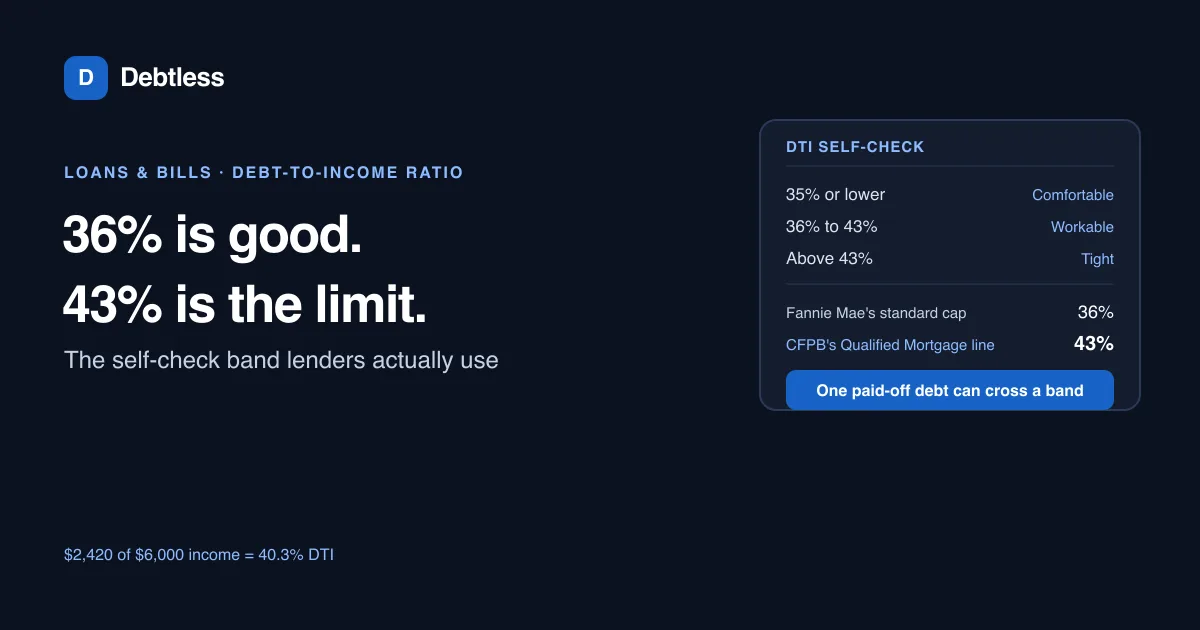
The short answer
A good debt-to-income ratio is 36% or lower, the standard cap Fannie Mae sets for manually underwritten conventional loans, and Experian treats anything at or below 35% as comfortable. Once the ratio passes 43%, the line the CFPB built its Qualified Mortgage rule around, most lenders stop offering their best terms and some stop approving the loan at all. Between those two numbers sits a band where you can usually still qualify, just not at the best price, and that's where paying down debt before you apply tends to move the needle fastest.
Where does your ratio actually fall?
Debt-to-income ratio, or DTI, is your total minimum monthly debt payments divided by your gross monthly income, shown as a percentage. Add up every required payment, your mortgage or rent only if you're applying with it attached, car loans, student loans, personal loans, and the minimum due on every credit card, then divide by what you earn before taxes.
The table below sorts that number into the same three bands a lender works from: Fannie Mae's standard 36% cap for conventional loans underwritten by hand, the stretch up to 43% and beyond where the CFPB's Qualified Mortgage rule starts to apply, and the comfortable range Experian calls out under 35%. Where you land changes what a lender will offer, not just whether they'll say yes.
How do you calculate your own number?
Start with your gross monthly income from a recent pay stub, then list every recurring debt payment with a fixed due date and minimum amount. What counts as debt? A plain list for your inventory is a useful checklist if you're unsure whether something like a 0%-financed phone or a loan from a family member belongs in that total.
Divide the debt total by the income total and move the decimal two places to read it as a percentage. Lenders usually run this math twice, once for the new loan payment alone and once for every debt you're carrying plus the new payment, and it's that second, fuller number the bands below are describing.
What should you do if your ratio lands in the middle band?
A DTI between roughly 36% and 43% usually still gets approved, just with a lender holding less room to work with on terms. The fastest way to move out of that band before you apply is to retire a recurring payment entirely rather than just making a larger dent in a balance, since closing out one debt removes its whole minimum payment from the ratio instead of shrinking it.
A debt payoff plan built around your actual balances, rates and minimums shows which account is closest to paid off and how long that takes at a given monthly budget, which is a more useful question than making extra payments at random.
What happens if your DTI is already above 43%?
A DTI above 43% doesn't rule out every loan. Fannie Mae's own Selling Guide allows conventional loans with a DTI as high as 45% for borrowers with strong credit and cash reserves, and up to 50% when the loan runs through its automated underwriting system, while FHA loans built around different rules can go higher still in some cases.
A personal loan runs into DTI the same way a mortgage does. How to Get a Personal Loan: A Step-by-Step Guide covers the credit and income checks a lender runs before quoting a rate, and a high DTI is one of the things that pushes that quoted rate up even when you're still approved.
Self-check: where does your DTI put you?
| DTI range | What it typically means | A reasonable next step |
|---|---|---|
| 35% or lower | Experian calls this comfortable; most lenders see low risk | Keep your current habits; you likely qualify for the best rates offered |
| 36% to 43% | At or past Fannie Mae's standard cap; still workable, but lenders tighten pricing and documentation | Pay off one recurring debt entirely rather than spreading extra cash across several |
| Above 43% | Past the line the CFPB built its Qualified Mortgage rule around; approval depends on compensating factors | Build a focused payoff plan before applying, or expect a higher rate if you proceed now |
Bands reflect Fannie Mae's standard conventional-loan cap, the CFPB's Qualified Mortgage threshold and Experian's guidance on a comfortable ratio.
Worked example · illustrative numbers
Example: crossing from one band into the next
Take a hypothetical household earning $6,000 a month before taxes, with $1,700 in rent, a $320 car payment, $260 in combined credit card minimums and a $140 student loan payment. That's $2,420 in monthly debt, for a DTI of 40.3%, inside the 36%-to-43% band: workable, but not the band that gets the best rate.
Paying off the $320 car loan removes its entire payment from the total rather than just shrinking it. Monthly debt drops to $2,100, and the DTI drops to 35.0%, moving the household from the middle band into the comfortable range in one step, the same move a lender would see on a new application.
Put this into practice with Debtless
Debtless's free payoff calculator lets you test which debt to pay off first using your actual balances and rates, so you can see which account closes out fastest and how much that lowers your monthly debt total before you apply for anything.

Common questions
Is a 43% DTI too high to get approved for a mortgage?
Not automatically. 43% is the threshold the CFPB's original Qualified Mortgage rule was built around, but Fannie Mae's own guidelines allow conventional loans above that with strong credit scores and cash reserves, and FHA loans run on different limits entirely. A DTI above 43% usually means a narrower set of options, not zero options.
Does my current rent count toward DTI if I'm buying a home?
No. Once you're applying for a mortgage to replace your rent, the rent itself drops out of the calculation and the new mortgage payment takes its place. An auto lender or a new landlord screening a lease application may still count current rent, since they're not replacing it.
Does debt-to-income ratio affect my credit score?
No. Credit bureaus don't have your income, so a lender calculates DTI separately at the time you apply, using the income and debts you report.
What's the fastest way to lower a DTI before applying for a loan?
Paying off an entire account, even a small one, removes its whole minimum payment from the ratio and tends to move the number more than spreading the same extra cash across several balances. Avoiding new financed purchases in the months before you apply matters just as much, since any new minimum payment adds straight to the total.
Sources & further reading
- CFPB: What is a Qualified Mortgage?
- Fannie Mae Selling Guide: B3-6-02, Debt-to-Income Ratios
- Experian: What Is Debt-to-Income Ratio?
General education for U.S. readers, not individualized financial, legal or tax advice. Examples are hypothetical; lender terms and actual interest calculations can differ. Check your current statements and agreements.
Published by Debtless with AI-assisted drafting. How this journal is made · Suggest a correction