 Debtless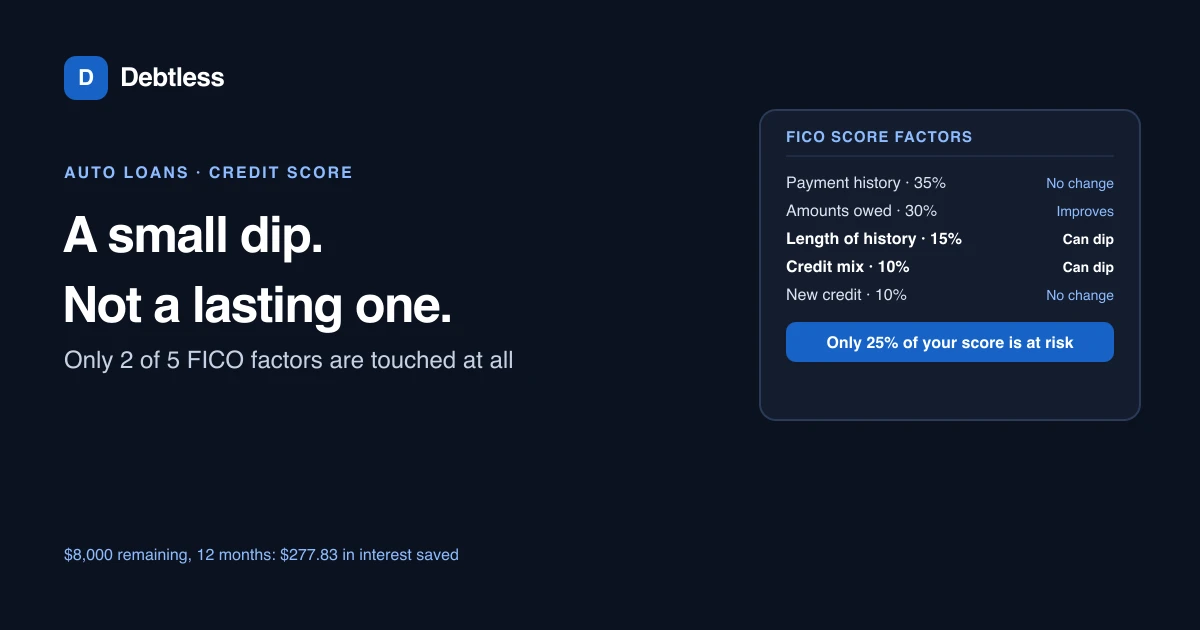
The short answer
Paying off a car loan early can cause a small, temporary dip in your credit score rather than a lasting hurt. Closing the account can shrink your credit mix and shorten your average age of accounts, two factors that together make up about a quarter of a FICO Score, according to myFICO's own breakdown of how scores are calculated. For most borrowers who have other open accounts, the dip is minor and fades within a few months, while the guaranteed interest you stop paying keeps its value the whole time.
The direct answer: a small dip, not a lasting one
A FICO Score is built from five weighted categories: payment history at 35%, amounts owed at 30%, length of credit history at 15%, credit mix at 10%, and new credit at 10%, according to myFICO. Paying off a car loan early doesn't touch payment history, amounts owed, or new credit in a negative way at all. It only reaches into the two smaller categories, length of credit history and credit mix, and only if that loan happened to be one of your oldest accounts or your only installment loan.
That's the entire mechanism. Nothing gets reported as a penalty for paying early, and no flag on your file says you closed something ahead of schedule. When a dip happens, it comes from what closing the account removes from your file, not from the payoff itself.
What actually changes on your report
Once the loan is paid off, the account status changes from an open installment loan to a closed one with a $0 balance. It stops adding new monthly payment history going forward, but according to Experian, a closed account in good standing doesn't disappear from your report right away and keeps contributing to your credit history for years after it's closed.
If that loan was your only installment account, your credit mix temporarily shows only revolving credit, like cards, until you open another installment loan, a mortgage, or something similar. And if it was one of your older accounts, the average age of your open accounts can tick down slightly the moment it moves to closed status.
Why this is different from paying off a credit card
Paying down a credit card usually helps a score, because it lowers your credit utilization, the share of your available revolving credit you're using, which sits inside the 30% amounts-owed category. An installment loan like a car loan doesn't work the same way; FICO treats the remaining balance on a fixed-term loan differently than a revolving balance, so paying it off early doesn't produce the same utilization boost, and instead interacts with the mix and age categories described above.
That distinction is why the same action, paying off debt early, can nudge a score in opposite directions depending on which kind of account you're closing.
Should you still pay it off early?
In most cases, yes. A temporary, small dip in two 10-to-15% categories rarely outweighs the interest you stop paying the moment the loan is gone, and interest on an installment loan is front-loaded, meaning a larger share of your early payments goes toward interest than your later ones do; Amortization: why early loan payments are mostly interest walks through why that timing matters.
If the car loan is one of several debts competing for the same monthly budget, it's worth sizing it up against the others before deciding what to pay off first. How long does it take to pay off $10,000 in debt? is a useful comparison point for a similar-sized balance, and if you're working with a smaller amount on a tighter timeline, How to pay off $5,000 in one year lays out what that pace actually requires.
FICO factors touched by an early auto loan payoff
| FICO factor | Weight | Affected by paying off a car loan early? |
|---|---|---|
| Payment history | 35% | No, your on-time record stays on your report |
| Amounts owed | 30% | Improves, the loan balance drops to $0 |
| Length of credit history | 15% | Can dip slightly if it was one of your oldest open accounts |
| Credit mix | 10% | Can dip if it was your only installment loan |
| New credit | 10% | No, paying off a loan isn't a new inquiry |
FICO Score factor weights per myFICO's breakdown of what's in a FICO Score. The actual point impact of any single account change varies by credit profile and isn't published by FICO.
Worked example · illustrative numbers
Example: what's actually at stake on a $8,000 balance
Take a hypothetical auto loan with $8,000 remaining and 12 months left on the note at 6.35%, the average new-car loan rate Experian reported for the second quarter of 2026. Ridden out to term, the monthly payment comes to $689.82, and the total interest still to be paid over those 12 months is $277.83.
Pay off the $8,000 today instead, and that $277.83 in future interest is gone for good. Weighed against a small, temporary dip in two categories that together make up a quarter of a FICO Score, on an account that will keep contributing to your credit history for years after it closes, the math tends to favor paying it off, especially if that freed-up $689.82 a month can go toward higher-rate debt elsewhere.
Put this into practice with Debtless
Debtless tracks an auto loan the same way it tracks every other debt, by balance, rate and term, so once you pay it off you can immediately see how much of your monthly budget just freed up to put toward what's left in the free iPhone app.

Common questions
Will paying off my car loan early definitely lower my score?
Not definitely. It depends on your overall credit file. If you have other open installment loans and a longer credit history elsewhere, the effect on credit mix and account age is often too small to notice.
How long does the dip last?
Industry sources describe it as small and temporary, typically fading within a few months as your other accounts continue reporting positive payment history.
Does this apply to paying off a mortgage or student loan early too?
Yes. The same credit mix and length-of-history mechanics apply to any installment loan, including a mortgage or student loan, since FICO treats them as the same account type for scoring purposes.
Should I avoid paying off my car loan early to protect my score?
Generally no. A few points of temporary dip rarely outweighs the guaranteed interest you stop paying, particularly if that loan carries a higher rate than other debt you're still carrying.
Sources & further reading
- myFICO: What's in your FICO Score
- Experian: Will paying off a loan early help my credit?
- Experian: Average car payment, Q2 2026
General education for U.S. readers, not individualized financial, legal or tax advice. Examples are hypothetical; lender terms and actual interest calculations can differ. Check your current statements and agreements.
Published by Debtless with AI-assisted drafting. How this journal is made · Suggest a correction