 Debtless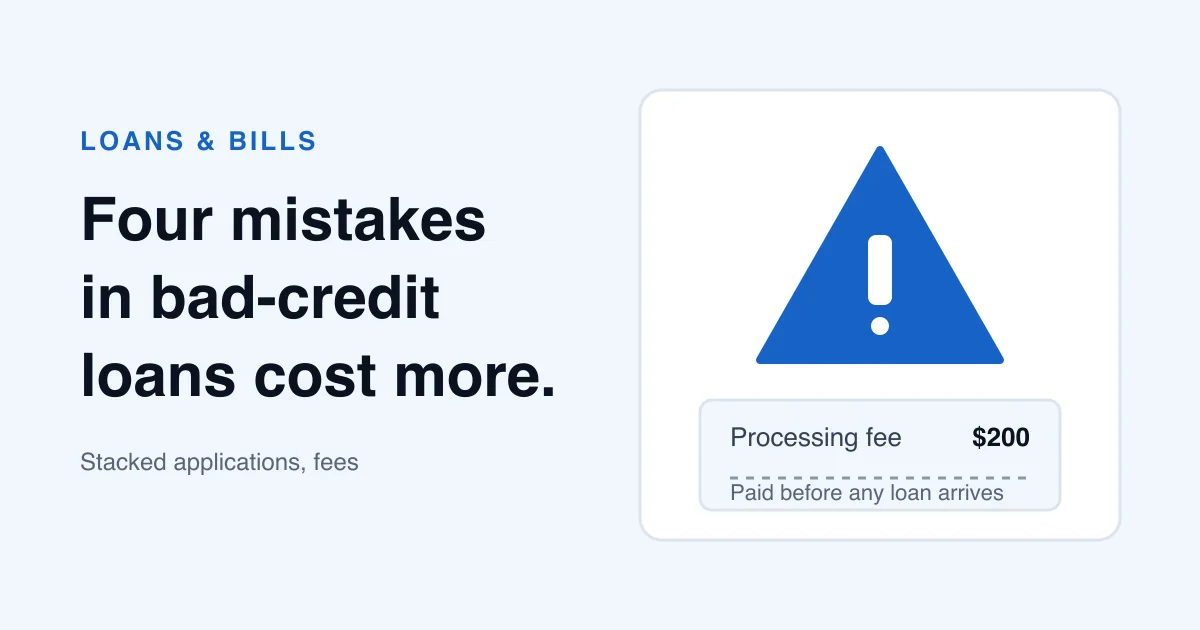
The short answer
Loans for terrible credit are personal or short-term loans offered to borrowers with low scores, and the costly mistakes are applying everywhere at once, paying a fee before any money arrives, skipping your own credit report, and borrowing without a repayment plan. FICO says multiple hard inquiries for the same kind of loan can count as one when they fall inside a 14-day or 45-day window, depending on the scoring version. The FTC says any up-front fee a lender wants before granting the loan is a cue to walk away.
Does applying to several lenders in one week hurt your score?
It can, but a short burst of applications is not automatically a disaster. myFICO explains that FICO Scores group multiple hard inquiries made within a short window into one inquiry. For older FICO versions that window is any 14-day span, and for newer versions it is any 45-day span. Applications spread over three weeks can therefore count separately under an older model, even if they look like one shopping trip to you. The myFICO page describes this grouping as a way to compare rates. It does not say that personal loans get the same treatment as mortgages, auto loans and student loans.
The real mistake is applying before you know what a lender will charge. Many lenders offer a prequalification check that uses a soft inquiry, which does not affect your score. Ask each lender which check it runs first. Use the soft check to compare offers, and submit a full application only for the one you plan to accept. How to Pick a Personal Loan Lender covers how to line up offers before you apply.
Why should an upfront fee make you walk away?
Advance-fee loan scams collect money before any loan exists. The FTC lists warning signs, including promises such as “Bad credit? No problem,” and fees the company never disclosed before you applied. The agency puts its rule plainly: “Any up-front fee that the lender wants to collect before granting the loan is a cue to walk away, especially if you're told it's for ‘insurance,’ ‘processing,’ or just ‘paperwork.’”
Legitimate lenders can charge application or appraisal fees, so a fee alone is not proof of fraud. The difference is timing and disclosure. A real lender shows its charges in the loan documents and does not ask for money before it has approved you. The FTC also notes that nobody legitimate will say a fee guarantees you will get the loan.
Should you check your credit report before you apply?
Yes, because an error on your report can make a lender price you as a bigger risk than you are. The CFPB explains that fixing an error generally means contacting both the credit reporting company and the company that supplied the information. The company that furnished the information generally must investigate and respond within 30 days of receiving your dispute.
Look for accounts you do not recognize, balances that are too high, and late payments you know you made on time. Start any dispute before you apply. A lender that pulls a report with an error will price from that report.
Then compare the report to your own records. If you keep a debt list or a spreadsheet, put each account on it next to what the report shows. Any gap is a question to settle before a lender sees it.
What should a new loan do to your debt list?
A loan used to pay off other debts still adds a payment to your list. Before you sign, add the loan with its APR, minimum payment and due date. Then check the total monthly outflow against your take-home pay, not the loan's payment on its own. Next, look at your debt-free date with and without the loan. If the date moves later, the new loan costs you time as well as money. That can still be the right call, but you should see it before you sign.
If the loan would mainly move debt from one account to another, compare it against a nonprofit plan first. Debt Management Plan vs. Consolidation Loan explains how the two differ in cost and in what they require from you.
Worked example · illustrative numbers
Example: a $1,500 offer that asks for $200 first
Imagine an online ad promising a $1,500 loan for bad credit. After you apply, the company asks for a $200 processing fee by debit card before it releases any funds. The fee is due before the loan has been approved.
Paying that fee with a credit card at 28% APR costs about $4.67 in interest in the first month, which is $200 times 28% divided by 12. The interest is small. The larger cost is the $200 itself. If the loan never arrives, you are out $200 and still need the $1,500, which is the pattern the FTC warns about.
A legitimate lender would show its fees in the disclosure before you agree, and it would not require payment ahead of approval. Stop at the upfront request and compare the next offer on its written terms.
This is a hypothetical example. The company and the fee are invented for illustration.
Put this into practice with Debtless
Debtless is a free iPhone app with no subscription, ads or bank linking. Add each debt by hand, including a loan you are considering, and the Plan tab shows how the new payment changes your projected debt-free date. It does not approve loans or check lenders, so the lender checks are still yours to make.

Common questions
Will prequalifying hurt my credit score?
Many lenders use a soft inquiry for prequalification, which does not affect your score. Ask which check the lender runs before you agree to anything, and confirm the answer in writing.
Is a loan with no credit check a safe option?
Treat it with caution. The FTC lists claims such as guaranteed approval as warning signs. Read the total cost in the disclosure before you accept, because a loan that skips the credit check can still carry high fees.
Should I talk to a credit counselor before borrowing?
Often it helps. A nonprofit counselor can review your full debt list and suggest options that do not add a new loan. Ask about fees before you book a session.
Sources & further reading
- FTC: What To Know About Advance-Fee Loans
- myFICO: Do Credit Inquiries Lower Your FICO Score?
- CFPB: How do I dispute an error on my credit report?
General education for U.S. readers, not individualized financial, legal or tax advice. Examples are hypothetical; lender terms and actual interest calculations can differ. Check your current statements and agreements.
Published by Debtless with AI-assisted drafting. How this journal is made · Suggest a correction