 Debtless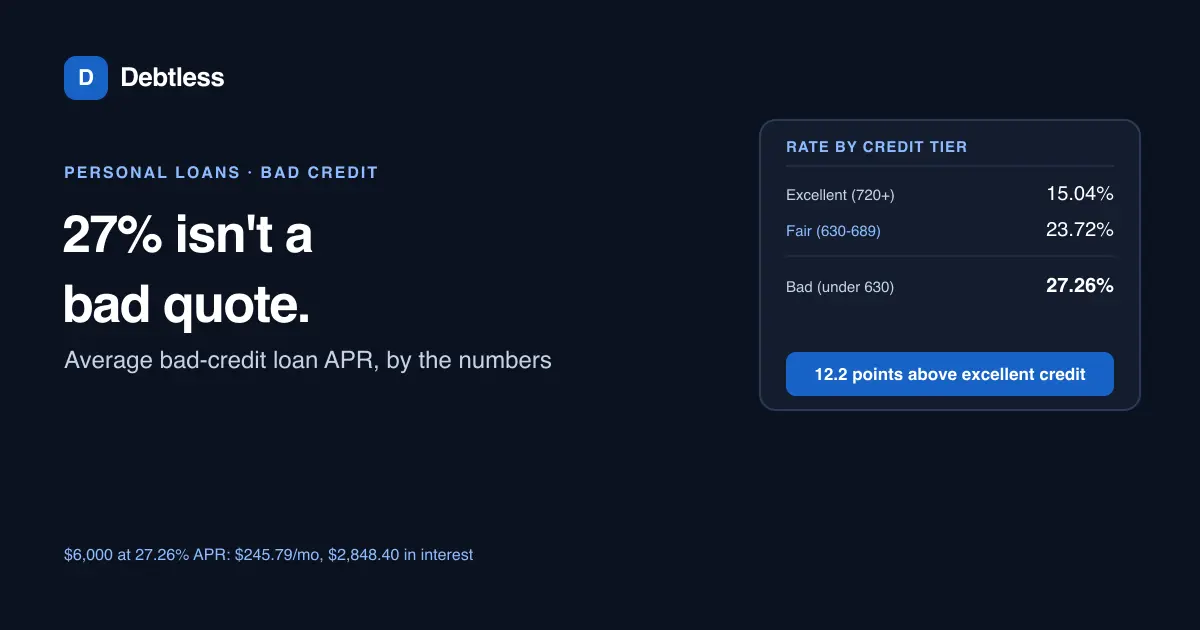
The short answer
A loan for bad credit is priced on risk: NerdWallet's October 2026 data puts the average APR at 27.26% for scores under 630, versus 15.04% for excellent credit, and Bankrate puts the realistic ceiling as high as 36%. That rate still beats many credit cards, but a 0%-APR balance transfer or simply paying down the highest-rate card first can cost less, depending on how fast the balance actually gets paid off.
What rate can you actually expect with bad credit?
Personal loan pricing runs almost entirely on credit score. NerdWallet's October 2026 breakdown shows an average APR of 15.04% for scores of 720 and up, 19.53% for the 690-to-719 range, 23.72% for 630 to 689, and 27.26% for anything under 630, the range most lenders label bad credit.
Bankrate's own data puts the realistic ceiling at almost 36%. A 27% quote on a bad-credit application is close to what the market actually charges at that score, and shopping around within that tier still turns up meaningful differences between lenders quoting the same applicant.
Is a balance transfer cheaper than a bad-credit loan?
A balance transfer card swaps the interest problem for a fee and a deadline instead. Transfer fees typically run 3% to 5% of the amount moved, and the 0% introductory period on the best cards usually runs 15 to 21 months, after which the remaining balance reverts to the card's regular APR.
The math favors the transfer only if the balance gets paid off inside that window; a debt consolidation loan spreads the same payoff over a longer, fixed term instead, which matters if the monthly payment a short transfer window demands doesn't fit the budget.
Does settling the debt hurt your credit more than borrowing does?
Settling for less than you owe is its own path, and it's a rougher one on a credit report than taking out a new loan. InCharge Debt Solutions, a nonprofit credit counseling agency, puts the typical hit at around 100 points, with the settled account staying on the report for seven years.
A new personal loan causes a smaller, shorter dip from the credit inquiry and the new account, then helps the score as it reports on-time payments. What a Lower Credit Card APR Actually Saves You covers the math on how much a lower rate is worth, which is worth keeping in view while deciding whether a new loan justifies the credit check.
What if you just pay down the cards you already have?
Paying off multiple cards at once doesn't require a new loan or account at all, just an order to attack them in. The debt avalanche method pays the highest-rate balance first to minimize total interest, while the debt snowball method clears the smallest balance first for faster wins; Debt snowball vs. avalanche: which debt goes first? compares both with a worked example.
That route skips the credit check, the origination fee and the new account entirely, a real advantage if a bad-credit score is itself the reason a loan or transfer card isn't approved at a workable rate in the first place. It also leaves the door open to revisit a loan or transfer later, once a few months of on-time payments have moved the score into a cheaper tier.
Average personal loan APR by credit tier, October 2026
| Credit tier | Score range | Average APR |
|---|---|---|
| Excellent | 720-850 | 15.04% |
| Good | 690-719 | 19.53% |
| Fair | 630-689 | 23.72% |
| Bad | Under 630 | 27.26% |
Per NerdWallet's October 2026 personal loan rate data; individual offers vary by lender, loan amount and term.
Worked example · illustrative numbers
Example: $6,000 two ways with a 610 credit score
Picture $6,000 spread across two store cards, with a 610 credit score. A personal loan at the 27.26% bad-credit average, paid over 36 months, runs $245.79 a month and $2,848.40 in total interest.
The same $6,000 moved to a balance transfer card with a 3% fee and an 18-month 0% intro period costs $6,180 upfront and $343.33 a month to clear it inside the promo window, with no interest at all if it's paid off on time, just the $180 fee. The transfer wins on cost here, but only because the higher monthly payment is realistic; stretched past 18 months, the remaining balance starts accruing the card's regular APR instead, which can erase the savings fast on whatever is still outstanding.
Put this into practice with Debtless
Debtless compares avalanche, snowball and a custom order side by side on your actual balances and rates, so you can see whether a new loan, a transfer, or just reordering your current cards gets you debt-free sooner, inside the free iPhone app's payoff calculator.

Common questions
Can you get a personal loan with a credit score under 600?
Often yes. NerdWallet's data shows an average APR of 27.26% for scores under 630, and Bankrate puts the realistic ceiling near 36%, so approval is common, just at a materially higher rate than good credit gets.
Is a balance transfer always better than a bad-credit personal loan?
Only if the balance gets paid off before the 0% intro period ends, typically 15 to 21 months. Past that window, the card's regular APR applies to whatever's left, which can cost more than the loan would have.
Does debt settlement hurt your credit score more than taking out a loan?
Generally yes. A settled account can cost around 100 points and stays on a credit report for seven years, according to InCharge Debt Solutions, while a new loan causes a smaller, shorter dip that recovers as it reports on-time payments.
What's the cheapest way to pay off multiple credit cards?
If a lower-rate loan or transfer card isn't available, the debt avalanche method, paying the highest-APR balance first, minimizes total interest without opening any new account at all.
Sources & further reading
- NerdWallet: Average Personal Loan Interest Rates
- Bankrate: Best Bad Credit Loans
- Experian: How to Avoid Balance Transfer Credit Card Fees
- InCharge Debt Solutions: Debt Settlement vs. Credit Score
General education for U.S. readers, not individualized financial, legal or tax advice. Examples are hypothetical; lender terms and actual interest calculations can differ. Check your current statements and agreements.
Published by Debtless with AI-assisted drafting. How this journal is made · Suggest a correction