 Debtless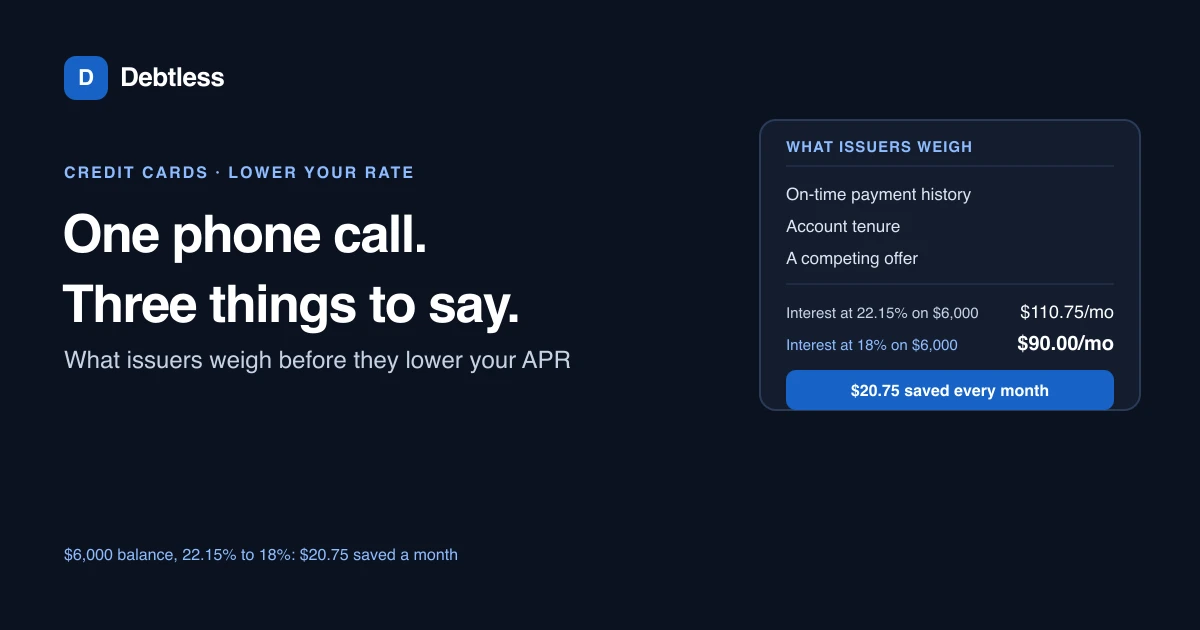
The short answer
You negotiate a lower credit card interest rate by calling the number on the back of the card and asking the account services or retention line whether a lower APR is available on your account. According to the Consumer Financial Protection Bureau, issuers already have to re-review certain accounts for a rate reduction at least every six months, and on a call a representative typically weighs your on-time payment history, how long you've held the account, and any competing offer you can point to. On a $6,000 balance, the difference between the 22.15% average rate the Federal Reserve reported for card accounts assessed interest in the second quarter of 2026 and an 18% rate an issuer might agree to is about $20.75 a month in interest alone.
The call costs nothing and doesn't require an application
Asking your own card issuer to lower the rate on an account you already have isn't a new credit application. There's no new inquiry to authorize and no paperwork to fill out first; you're asking a representative to review a rate you're already paying. The number on the back of the card usually routes to general customer service, and asking to be transferred to "account services" or "retention" gets you to someone with more room to negotiate on rate.
According to the CFPB, card issuers are required to periodically re-evaluate a customer's rate under certain circumstances, most clearly when a rate was previously raised as a penalty. A representative reviewing your account for a voluntary reduction is doing something similar on a smaller scale: checking whether the reasons for your current rate still make sense given how you've actually used the account.
What issuers actually weigh
Three things come up in almost every version of this conversation, and having them ready before you dial is most of the preparation involved.
Your on-time payment history carries the most weight, which lines up with how payment history is scored generally: it's consistently the single largest factor in a credit profile, and issuers use a version of that same signal internally. Longer account tenure works in your favor too, since a representative would rather keep a customer who's stuck around than risk losing one. And if you have a specific competing offer, a balance-transfer rate or a new-card APR from another issuer, naming the actual number gives the representative something concrete to match or beat instead of a vague request.
If they say yes, confirm three things before you hang up
A rate reduction isn't always what it sounds like on first mention. Before you end the call, confirm the effective date, since a lower rate that only applies to new purchases won't touch the balance you're carrying right now. Ask whether it covers your entire balance or just part of it, and ask whether it's permanent or a temporary promotional window that reverts after a set number of months.
It's also worth asking for the new rate in writing, either mailed or noted in your online account, so there's a record to point back to if your next statement doesn't reflect what you were told on the phone.
If they say no, the balance still has options
A representative can decline without giving much of a reason, and there's no appeal process built into the call. If that happens, you can ask again in a few months once you've built a longer stretch of on-time payments, or shift your attention to the balance itself rather than the rate attached to it.
Interest on a card keeps accruing daily on whatever balance is left, which is part of why a flat rate cut matters less than it might seem once you understand the mechanics; Daily periodic rate: how card interest adds up walks through how that compounding actually works. And if you're carrying more than one card at a similar rate and trying to decide which to attack first, What to do when two debts have the same interest rate covers the tiebreakers worth using instead of picking at random.
What issuers weigh on a rate-reduction call
| Factor | Why it matters | How to bring it up |
|---|---|---|
| On-time payment history | The largest factor in how issuers view an account's risk | Mention how many consecutive on-time payments you've made |
| Account tenure | A longer relationship reads as a customer worth keeping | State how many years you've held the card |
| A competing offer | Gives the representative a specific number to match or beat | Have the balance-transfer or new-card APR in hand before you call |
Based on Consumer Financial Protection Bureau guidance on credit card interest rate reviews.
Worked example · illustrative numbers
Example: a 4-point rate cut on a $6,000 balance
Take a hypothetical $6,000 balance sitting at 22.15%, the Federal Reserve's reported average rate for card accounts assessed interest in the second quarter of 2026. At that rate, interest alone runs $110.75 in a single month, before any payment is applied to principal.
If a call gets that same balance down to 18%, the monthly interest drops to $90.00, a savings of $20.75 a month. That's $249 over a year on the same $6,000, without paying down a single extra dollar of the balance itself. If that $20.75 goes toward principal instead of disappearing into a lower bill, the balance actually shrinks faster on top of the savings.
Put this into practice with Debtless
Whatever rate you end up with, Debtless's free payoff calculator recalculates your payoff date the moment you update a card's APR, so a successful call shows up immediately as a shorter timeline instead of just a smaller number on a statement.

Common questions
Does asking for a lower APR hurt my credit score?
No. Asking your own issuer to review the rate on an account you already have isn't a new credit application, so it doesn't trigger the kind of hard inquiry that opening a new card would.
How often do issuers review my rate on their own?
If your rate was raised as a penalty, such as after a late payment, federal rules require the issuer to review it at least every six months and lower it if the reasons for the increase no longer apply, according to the CFPB. Routine requests outside that situation aren't on a fixed schedule.
What happens if the issuer says no?
Nothing changes on your account. You can ask again after a few more months of on-time payments, or focus on paying down the balance itself rather than the rate attached to it.
Is a lower rate offer always permanent?
Not always. Confirm whether the reduction applies to your whole balance or new purchases only, and ask whether it's permanent or a temporary promotional rate that reverts later.
Sources & further reading
- CFPB: When can my credit card company increase my interest rate, and how can I get it back down?
- Federal Reserve: Consumer Credit G.19, credit card interest rates
General education for U.S. readers, not individualized financial, legal or tax advice. Examples are hypothetical; lender terms and actual interest calculations can differ. Check your current statements and agreements.
Published by Debtless with AI-assisted drafting. How this journal is made · Suggest a correction