 Debtless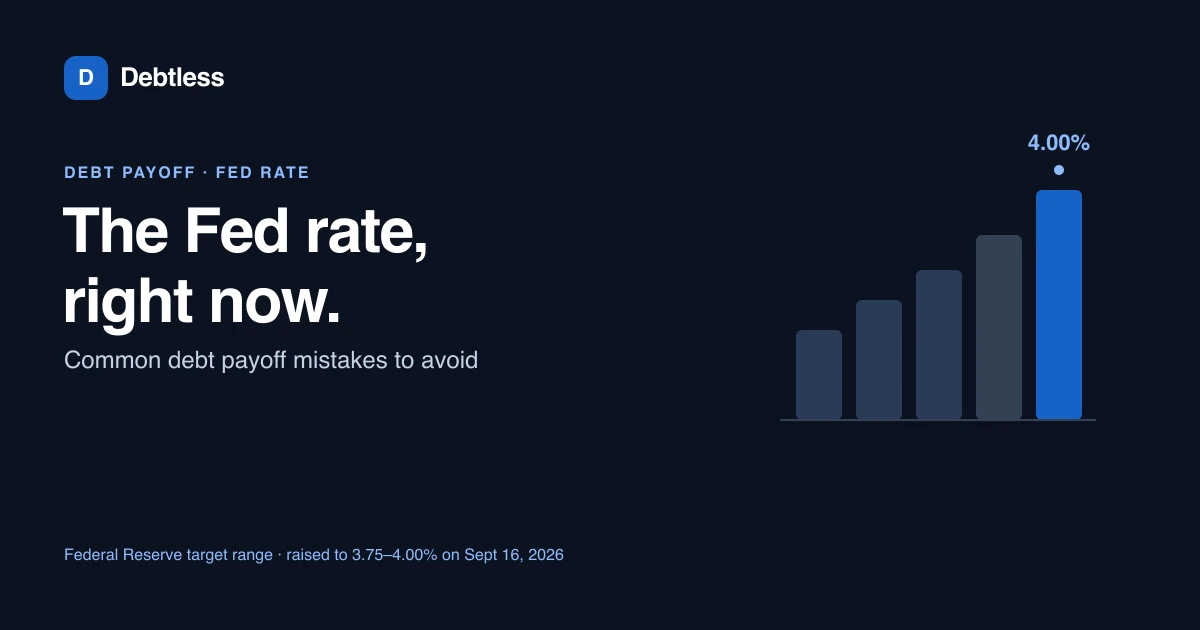
The short answer
The Federal Reserve raised its target rate to a range of 3.75% to 4.00% on September 16, 2026, its first hike since 2023. The most common mistake right after a move like this is assuming it only touches new loans, since variable-rate credit cards can reprice within a single billing cycle. The second is waiting on the Fed's next meeting instead of checking what your own statement already changed to.
Why a Fed decision reaches your credit card bill before your mailbox does
A Fed decision is really a decision about the federal funds rate, the rate banks charge each other overnight. It doesn't set your credit card's APR directly. What it moves is the prime rate, the index most variable-rate cards use as a base, and prime typically shifts in step with the Fed's target range within a day or two of a decision.
According to the Consumer Financial Protection Bureau, a variable APR changes when its index does, most often the prime rate published in the Wall Street Journal, so a card marked "variable" can reprice before your next paper statement even prints.
If you're a reporter covering how the September rate move affects household debt, or just want background on Debtless itself, the Debtless press kit has figures and contacts.
Mistake 1: assuming only new debt is affected
It's easy to read a Fed headline and assume it only changes the rate on a car loan you haven't taken out yet or a mortgage you're not shopping for. Existing balances on variable-rate cards move too, usually inside the same billing cycle the index changes, not months later.
Fixed-rate debt, most installment loans, and most federal student loans don't reprice this way. The mistake is skipping the check: open your card agreement or the box on your last statement that lists "APR" and "fixed" or "variable" before assuming either way.
Mistake 2: waiting for a rate cut before paying anything extra
Some people decide to hold off on extra payments until rates come back down, reasoning that a lower rate later makes the debt cheaper to carry. That math rarely works out, because the rate you're paying today is already high.
The average APR on credit card accounts that carry a balance was 22.15% in the second quarter of 2026, up from 21.52% the quarter before, according to Federal Reserve data. Waiting for a future cut of a point or two doesn't change the fact that every month at 22% is expensive right now.
- Pull your most recent statement and find the APR listed for purchases.
- Check whether it's marked fixed or variable, and if variable, note the index named in your agreement.
- Compare that number to what you'd pay with $50 or $100 extra toward the balance this month instead of next quarter.
- If the rate did move, call the number on the back of the card and ask what changed and when.
Mistake 3: reading 25 basis points as your exact new APR
A quarter-point Fed move gets rounded in headlines to "rates went up," which makes it sound like every rate in your wallet moved by exactly that much. Card issuers add their own margin on top of the index, and not every issuer updates on the same day.
The only number that matters for your payoff plan is the APR printed on your next statement, not the number in a headline. The Debtless Journal has more on how card issuers calculate and apply that rate once your payment lands.
Fed-rate mistakes at a glance
| Common mistake | Better move |
|---|---|
| Assuming only new loans are affected | Check your statement: variable-rate cards can reprice within a billing cycle |
| Waiting for a rate cut to start paying extra | Compare today's average APR to the real cost of waiting a quarter or two |
| Treating 25 basis points as your new APR | Read the actual APR on your next statement; issuers add their own margin |
| Refinancing decisions based on headlines alone | Re-check your current agreement's index and margin before switching products |
Average APR figure is for credit card accounts assessed interest, Q2 2026, Federal Reserve G.19 release.
Worked example · illustrative numbers
Example: what a small APR move actually costs in a month
Say a $4,000 card balance carries a 22.00% APR. One month of interest on that balance, using balance times APR divided by 12, comes to $4,000 x 0.22 / 12 = $73.33.
If the rate ticks up a quarter point to 22.25%, the same balance costs $4,000 x 0.2225 / 12 = $74.17 that month, a difference of about $0.84, or roughly $10 over a year if the balance stayed flat. The 25 basis points itself isn't what wrecks a payoff plan. Carrying $4,000 at any rate above 20% for another year is the bigger number, and that number doesn't wait for the Fed.
Put this into practice with Debtless
Debtless won't tell you when your card's APR changed, since it doesn't connect to your bank or pull your statements. What it does is hold the number you enter for each debt and show how a change to that APR, or an extra payment, shifts your projected debt-free date. Try the free Debtless app on iPhone, and see our terms of use for what the app does and doesn't do.

Common questions
Does a Fed rate hike raise the APR on debt I already owe?
It can, for balances with a variable APR. Fixed-rate cards, most installment loans and federal student loans don't reprice with the Fed's target range. Check your statement's APR box to see which kind you have.
How is the prime rate related to the federal funds rate?
Prime is the index many U.S. banks use for variable consumer rates, and it typically moves in the same direction as the Fed's target range within a day or two of a decision. It's a reason to check your own accounts, not a substitute for reading your actual statement.
Should I wait for a rate cut before paying extra on my cards?
Waiting rarely pays off. The average APR on card balances that carry interest was above 22% in the second quarter of 2026, so a future cut of a point or two still leaves an expensive rate. Extra payments made now shrink the balance that any rate gets applied to.
Does Debtless update my APR automatically when the Fed moves?
No. Debtless doesn't link to your bank, so it can't see a rate change on its own. When your statement shows a new APR, you update that one number in the app and the Plan tab recalculates your projected payoff date.
Sources & further reading
- Federal Reserve: FOMC statement, September 16, 2026
- Federal Reserve: Consumer Credit (G.19)
- CFPB: Fixed APR vs. variable APR
General education for U.S. readers, not individualized financial, legal or tax advice. Examples are hypothetical; lender terms and actual interest calculations can differ. Check your current statements and agreements.
Published by Debtless with AI-assisted drafting. How this journal is made · Suggest a correction