 Debtless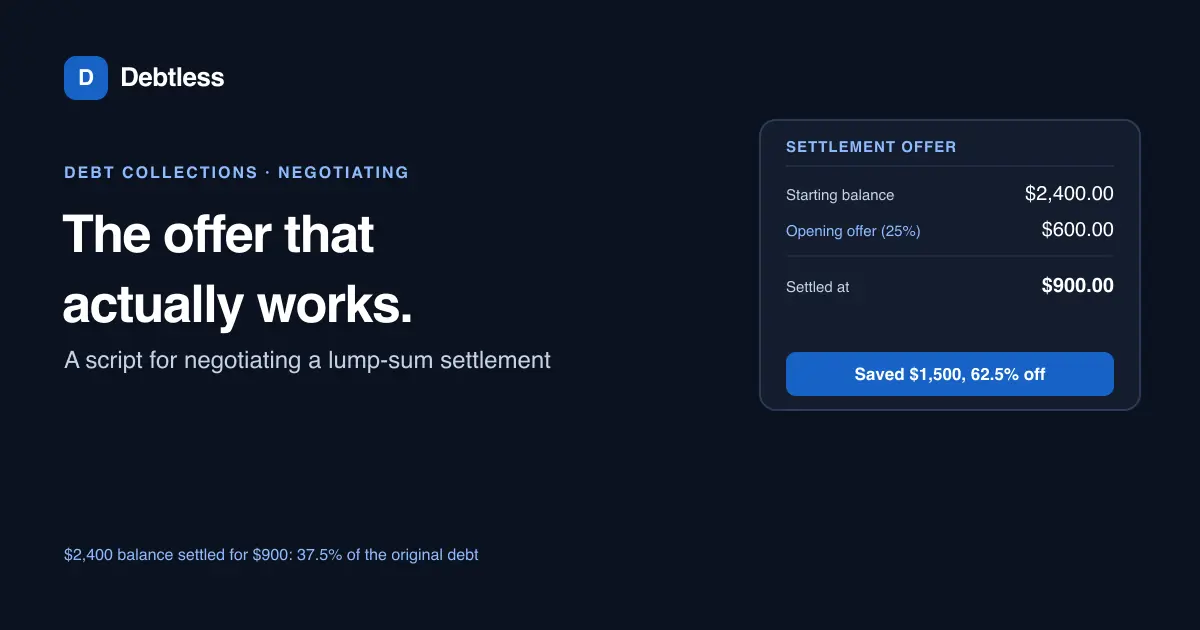
The short answer
Negotiating with a debt collector means offering a lump sum or short payment plan for less than you owe, and it works more often than not: Experian says collectors commonly accept a lump-sum payment of 25% to 50% of the balance, and CBS News reports industry data showing about 55% of enrolled accounts get settled. Confirm the debt is actually yours and the amount is right before you make an offer, start low, and never send money until the agreed terms are in writing.
Should you negotiate or ask for validation first?
A debt collector has to send you certain information about the debt, like the amount and the name of the original creditor, and federal law gives them five days from first contact to do it. Negotiating before that information arrives means arguing over a number you haven't confirmed is accurate or even yours; A debt collector called: what to do first covers the moves to make in that first conversation.
Once the account, the balance and the creditor check out, validation is done and negotiating a lower payoff is a separate move entirely. How to ask a collector to validate a debt walks through that request on its own, since mixing the two steps together is the most common way people weaken their own negotiating position before they've even made an offer.
How much will a collector actually settle for?
There's no fixed percentage a collector has to accept, but Experian's own guide to negotiating with collectors puts the common range at 25% to 50% of the balance for a lump-sum payment, with some accounts settling for as little as 20% and others refusing anything short of 80%, depending on the agency and the debt.
CBS News, reporting data from the American Fair Credit Council, found that debt relief companies settle around 55% of enrolled accounts within three years, and that successful settlements typically pay 30% to 50% less than the original balance. Those figures describe accounts worked by a third party; calling a collector yourself skips the fee a settlement company would charge on top of that.
How do you make the actual offer?
Call with the account number in hand, state what you believe you owe, and ask whether they'll accept a lump sum for less. Opening around 25% of the balance, the low end of Experian's typical range, leaves room to move up without starting where you'd already be happy to land.
- Confirm the balance and account number out loud before naming any dollar figure.
- Offer a specific lump sum, not a percentage, starting near 25% of what you owe.
- If they counter, move up in smaller increments than their jumps, and stop at your real ceiling.
- Ask them to send the agreed terms in writing before you schedule or send a payment.
What should you get in writing before you pay?
The CFPB is direct about this one: get the plan and the collector's promises in writing before you make a payment, including the exact settlement amount, confirmation that the account will show as paid, that collection activity stops, and the date the offer expires. A verbal agreement with nothing on paper leaves you with no recourse if the account gets sold to another collector before you finish paying.
Check the tax side too. The IRS generally treats forgiven debt as taxable income, and a creditor has to send a Form 1099-C for any single cancellation of $600 or more, so a $1,500 discount triggers a form the following January unless an exclusion like insolvency applies. Knowing that ahead of time beats finding out at tax season.
What collectors typically accept, by scenario
| Scenario | Typical range | What it means for your offer |
|---|---|---|
| Opening offer | Around 25% of the balance | Leaves room to move up without starting at your real limit |
| Common settlement | 25% to 50% of the balance | Where most lump-sum deals land, per Experian |
| Full range across agencies | 20% on the low end, 80% on the high end | Depends on the collector, the debt's age, and who currently owns it |
Ranges per Experian's guide to negotiating with debt collectors; settlement rate per CBS News reporting on American Fair Credit Council data.
Worked example · illustrative numbers
Example: a $2,400 balance settled at $900
Take a hypothetical $2,400 credit card debt now with a collection agency. An opening offer of $600, 25% of the balance, gets countered at $1,200, half the balance. Meeting in the middle at $900 lands at 37.5% of the original debt, squarely inside the 25%-to-50% range Experian describes as typical.
That $1,500 discount is real money saved, but it also clears the IRS's $600 cancellation-of-debt threshold by a wide margin, so expect a 1099-C for the forgiven amount and plan to report it as income unless an exclusion applies.
Put this into practice with Debtless
Once a settlement is signed, Debtless lets you update that account's balance to the new amount and see exactly how clearing it changes your overall debt-free date next to every other balance you're tracking, right inside the free iPhone app's payoff calculator.

Common questions
Can I negotiate with a collector before validating the debt?
You can, but it's risky. Confirming the balance, account and creditor first means you're negotiating a number you know is accurate, instead of settling an amount that might be wrong or already past the point a collector could legally sue over.
Will a debt collector really put a settlement in writing?
A legitimate one will, and the CFPB recommends treating any that won't as a reason to not send payment. The written agreement should state the exact amount, that it settles the account in full, and that collection activity stops.
Do I owe taxes on debt that gets forgiven through a settlement?
Often yes. The IRS generally counts forgiven debt as taxable income, and a creditor must issue a Form 1099-C for any single cancellation of $600 or more, though exclusions like insolvency can reduce or eliminate what you owe.
What's a reasonable opening offer to a debt collector?
Experian's guide points to roughly 25% of the balance as a typical starting offer, low enough to leave negotiating room but not so low that the collector won't engage at all.
Sources & further reading
- CFPB: How do I negotiate a settlement with a debt collector?
- Experian: How to Negotiate With Debt Collectors
- CBS News: What is the success rate of debt settlement?
- IRS: Instructions for Forms 1099-A and 1099-C
- IRS: Topic No. 432, Form 1099-C, Cancellation of Debt
General education for U.S. readers, not individualized financial, legal or tax advice. Examples are hypothetical; lender terms and actual interest calculations can differ. Check your current statements and agreements.
Published by Debtless with AI-assisted drafting. How this journal is made · Suggest a correction