 Debtless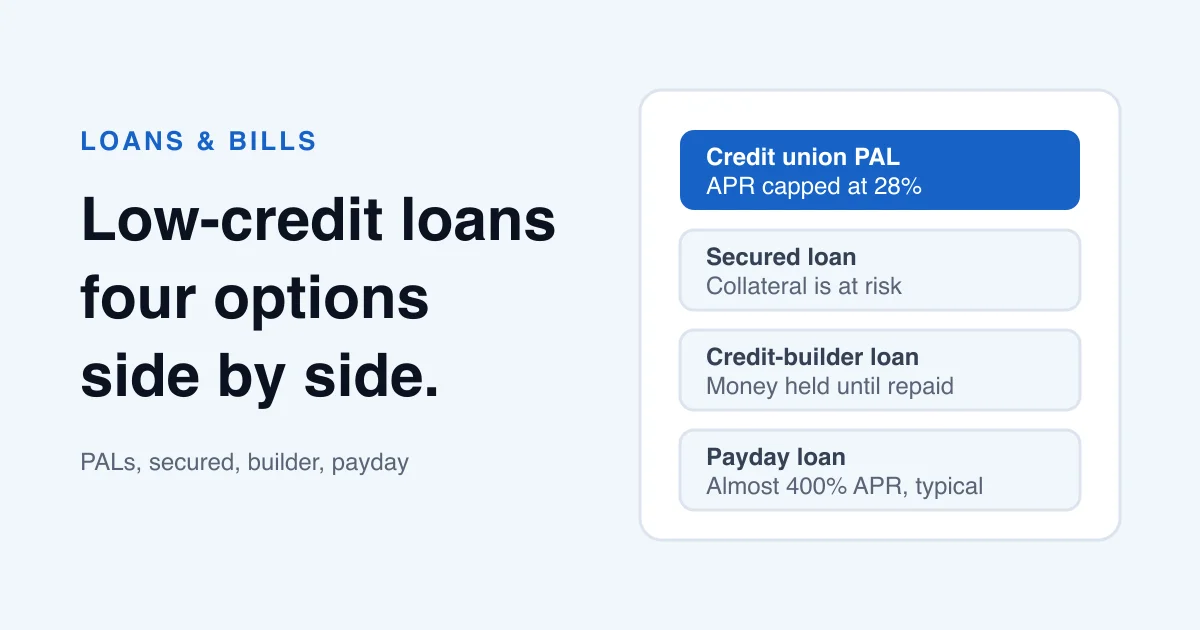
The short answer
Loans for low credit come in four main types: credit union payday alternative loans, secured loans, credit-builder loans and payday loans. Federal credit unions may charge up to 28% APR on payday alternative loans, according to NCUA, while the CFPB says a typical two-week payday loan with a $15 per $100 fee works out to an APR of almost 400 percent. Start with the credit union option, because its rate ceiling is set by federal rule.
Which low-credit loan has a federal price ceiling?
Federal credit union payday alternative loans have the clearest cap. NCUA says federal credit unions may charge up to 28 percent on payday alternative loans under its regulations. The PAL II rule lets a federal credit union lend up to $2,000 on a term of one to 12 months, and it prohibits rollovers.
Payday loans sit at the other end. The CFPB says many state laws set a maximum payday loan fee between $10 and $30 for every $100 borrowed. The same CFPB page gives context: credit card APRs typically range from 12 to 30 percent.
Online lenders and secured loans fall between those markers, and their prices depend on your profile. What a Bad-Credit Loan Actually Costs walks through how a higher APR changes the dollars on a real balance.
| Option | Price rule or typical cost | Limits | Main risk |
|---|---|---|---|
| Credit union PAL | APR capped at 28% | Up to $2,000; 1 to 12 months; no rollovers | A small amount may not cover a larger need |
| Secured loan | Set by the lender; collateral can lower the rate | Savings, a certificate of deposit or a vehicle | The collateral can be taken on default |
| Credit-builder loan | Set by the lender | Usually a small amount | Money is often held until repayment, and it helps only if payments are reported |
| Payday loan | Fees of $10 to $30 per $100 under many state caps | Typically due in full on your next payday | A rollover adds another fee |
Credit union and payday figures come from NCUA and CFPB pages. Secured and credit-builder terms vary by lender, so read each offer.
Why do payday loans reach an APR near 400%?
The math is simple once you divide the fee. The CFPB says a typical two-week payday loan with a $15 per $100 fee equates to an annual percentage rate of almost 400 percent. A $15 fee on $100 is 15% for two weeks. Repeat that across the 26 two-week periods in a year and the total comes out near 390%, the same range the CFPB describes.
The fee does not shrink if you pay late. Payday loans are typically due in full on your next payday, so a loan you cannot repay in full means paying another fee to push the due date back. That is why the term matters as much as the fee.
How do secured and credit-builder loans work?
A secured loan asks you to pledge something of value, such as a savings account, a certificate of deposit or a vehicle. Because the lender's risk drops, the rate can come in below an unsecured offer. The trade-off is the collateral. If you stop paying, the lender can take what you pledged, so check the default terms in the disclosure before you agree.
A credit-builder loan works the other way around. The lender typically holds the borrowed money while you make payments, so you receive it once the loan is repaid. Ask whether the lender reports your payments to the credit bureaus. If it does not, the loan may do little for your credit history.
Which option should you compare first?
Start with the credit union option if you can join one. Its 28% ceiling is set by federal rule, so you know the maximum before you apply. Then compare any secured or credit-builder offer against that ceiling, and treat a payday loan as the last option, since its cost depends heavily on how long it stays open.
Once you have a shortlist, How to Pick a Personal Loan Lender explains how to compare fees, not just the rate. If the need is bigger than a small loan can cover, or you already owe on several accounts, Debt Management Plan vs. Consolidation Loan compares the options that work at that scale.
Worked example · illustrative numbers
Example: a $1,200 car repair, two ways
Say a car repair costs $1,200. A credit union PAL at the 28% cap, repaid over 12 months, has a monthly payment of $115.81 and about $190 in total interest across the year. This example uses the cap as the rate, not a quote from any credit union.
A payday loan for the same $1,200 with a $15 per $100 fee charges $180 for two weeks. Paying in full on your next payday means $1,380 leaves your account in two weeks. If you roll it over instead, you pay another $180 each cycle and the $1,200 stays owed. Two rollovers cost $360 in fees, almost twice the PAL's full year of interest.
These figures are hypothetical. Check the actual disclosure before you agree to any loan.
Put this into practice with Debtless
Debtless is a free iPhone app with no subscription, ads or bank linking. Enter each loan's balance, APR, minimum payment and due date by hand, and the Plan tab projects a debt-free date across all of your debts. It does not choose a lender or offer credit, so the price comparison stays with you.

Common questions
What is a payday alternative loan?
It is a small installment loan from a federal credit union. NCUA caps the rate at 28%, and its PAL II rule allows up to $2,000 on a term of one to 12 months with no rollovers.
Do I need to join a credit union for a payday alternative loan?
Yes. These loans are made by federal credit unions to their members, so you need to be a member to borrow.
Will a secured loan help my credit score?
It can, but only if the lender reports on-time payments to the credit bureaus. Ask before you borrow, then check your report after a few payments to confirm the account appears.
Sources & further reading
- NCUA: Permissible Loan Interest Rate Ceiling Extended
- NCUA: Payday Alternative Loan Rule Will Create More Alternatives for Borrowers
- CFPB: What is a payday loan?
General education for U.S. readers, not individualized financial, legal or tax advice. Examples are hypothetical; lender terms and actual interest calculations can differ. Check your current statements and agreements.
Published by Debtless with AI-assisted drafting. How this journal is made · Suggest a correction