 Debtless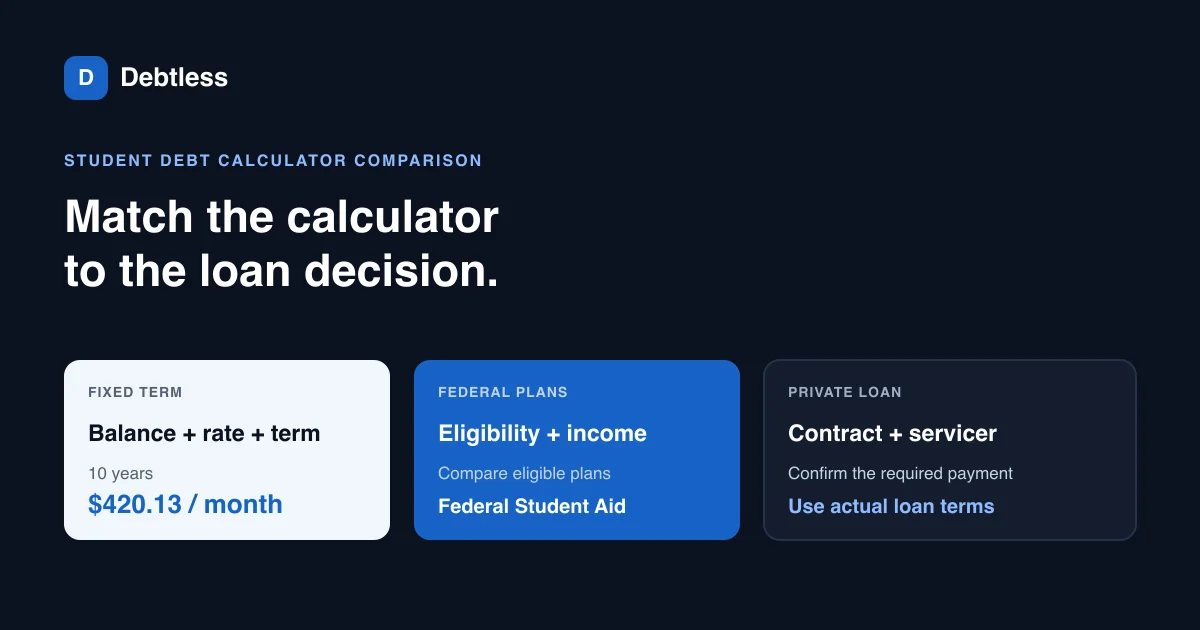
The short answer
A student debt payment calculator should match the kind of loan and the decision you need to make. Use a basic amortization calculator for a fixed-rate payment estimate, Federal Student Aid's Repayment Calculator for federal plan eligibility and income-based options, and a lender or servicer tool for a private loan's actual terms. For $37,000 at 6.5%, a simple fixed-payment model estimates $420.13 for 10 years, while a 20-year model lowers the payment to $275.86 and raises modeled interest by $15,791.59.
Which student debt payment calculator should you use?
Choose a student debt payment calculator based on the loan type, federal or private, and the result you need: a fixed-term estimate, an income-based payment, or a payoff plan. A basic loan calculator needs balance, rate, and term. It cannot determine federal repayment-plan eligibility from those three fields.
Federal Student Aid says its Repayment Calculator, formerly Loan Simulator, compares plans a borrower's loans are eligible for, estimated monthly payments, and estimated totals paid. It can also show principal and interest, a possible discharge amount, and an end-of-term date. Federal Student Aid cautions that the results are estimates and that the servicer sets the final terms after processing an application.
A private student loan follows its promissory note and lender rules. Use the lender or servicer schedule to confirm the rate, required payment, due date, and how extra money is applied. If you have both types, keep them as separate entries rather than forcing all balances into one federal scenario. A general calculator can still test a fixed extra payment after the official terms are known.
| Calculator type | Best question | Inputs it may need | Main limit |
|---|---|---|---|
| Basic amortization | What fixed payment repays this balance by a chosen term? | Balance, fixed rate, months | Does not test federal eligibility or income rules |
| Federal Student Aid Repayment Calculator | Which federal plans may I qualify for and what might each cost? | Loan details plus income and household information for some plans | Estimate until the servicer processes the choice |
| Private lender or servicer | What does my contract require and what posts to my account? | Account and contract terms | Usually limited to that lender's loans |
| Multi-debt payoff planner | Where does this loan fit beside cards, auto debt, and other balances? | Balances, APRs, minimums, extra budget | Does not enroll you in a repayment plan |
Start with loan type and decision. The calculator with the longest form is not automatically the right one.
What should you compare besides the monthly payment?
A student debt calculator comparison should include total paid, interest paid, repayment length, eligibility, and any estimated discharge alongside the monthly payment. A lower payment can result from a longer term, an income-based formula, or both. Those paths can produce very different totals and obligations.
Federal Student Aid recommends comparing options by monthly payment, total paid, and fastest payoff. Its current repayment-plan information also says eligibility depends on loan type and when the loan was disbursed. For example, Tiered Standard applies to Direct Loans and uses a fixed payment over 10 to 25 years depending on the amount borrowed. Older loans may have other fixed-plan choices, while income-driven calculations require information beyond the loan balance.
Use a short comparison sheet with the same headings for every result. Record the plan name, first payment, expected later payment when it changes, end date, estimated total, and eligibility condition. Flag any number that depends on annual income recertification or projected discharge. That makes an attractive low payment harder to mistake for the lowest total cost.
How do federal and private student loan calculations differ?
Federal and private student loan calculations differ because federal plans can use statutory eligibility and income rules, while private-loan payments generally follow the signed contract. A plain amortization formula can estimate a fixed private loan or a fixed federal schedule. It cannot reproduce every federal plan from balance and APR alone.
For a federal comparison, sign in to StudentAid.gov or enter the loan details manually in the official Repayment Calculator. Review which plans appear as eligible or ineligible and why. Federal Student Aid notes that income-based scenarios may require income, family size, tax filing status, and state of residence. A result that asks for none of those inputs cannot be a tailored income-driven estimate.
For a private loan, compare the calculator's first payment and final date with the current lender schedule. Check whether the rate is fixed or variable, whether payments are already in repayment, and whether extra payments reduce principal. The bank loan calculator mistakes guide covers term, fees, and payment-frequency errors that also affect private-loan estimates.
How can you compare student debt with your other loans?
You can compare student debt with other loans by keeping each required payment intact and placing every balance, APR, and minimum in one payoff plan. This broader view answers a different question from federal plan selection: where should an optional extra dollar go after all required payments are covered?
A student loan with a lower APR may sit behind a high-rate credit card in an avalanche order. A tiny student loan may come first in a snowball. Federal discharge or forgiveness goals can change the decision, because aggressively prepaying a balance expected to qualify for discharge may work against that strategy. Confirm program rules before treating every federal loan like an ordinary installment balance.
Use the Debtless snowball-versus-avalanche calculator only after you have the official required payment for each student loan. For a comparable auto-loan input check, the car payment calculator guide shows why term and amount financed belong beside the displayed payment. The same discipline keeps unrelated loan products from becoming one vague monthly number.
- Separate federal loans from private loans and record each servicer.
- Use the official federal calculator to compare eligible federal plans.
- Use the private lender's terms to confirm each private-loan payment.
- Record required payments before assigning any optional extra amount.
- Compare the combined plan again after a rate, income, or plan change.
Worked example · illustrative numbers
What does a fixed-term calculator show for $37,000 at 6.5%?
| Fixed term | Modeled monthly payment | Modeled interest | Modeled total paid |
|---|---|---|---|
| 10 years | $420.13 | $13,415.30 | $50,415.30 |
| 15 years | $322.31 | $21,015.75 | $58,015.75 |
| 20 years | $275.86 | $29,206.89 | $66,206.89 |
Hypothetical fixed-rate amortization with monthly payments, no fees, no deferment, and no discharge. This table compares terms; it does not claim these are the plans available to a specific federal or private borrower.
Put this into practice with Debtless
Debtless can hold the required payments you obtained from the federal calculator and private servicers, then model those loans beside other balances. Small irregular amounts can also be recorded as part of a plan; the debt snowflake guide explains how to keep those extras separate from the payment you can reliably repeat.

Common questions
Is a student debt payment calculator the same as Federal Student Aid's Repayment Calculator?
No. A generic calculator usually models balance, rate, term, and payment. The federal tool checks federal plan options and can use loan, income, and household information to estimate eligible repayment paths.
Why does a longer student loan term show a lower payment?
The balance is spread across more scheduled payments. In a fixed-rate model, that usually lowers the monthly amount and increases total interest because the balance remains outstanding longer.
Can a calculator tell me how much student debt will be forgiven?
An official federal calculator can estimate a discharge amount under eligible scenarios, but the estimate depends on program rules and future qualifying behavior. Confirm eligibility and required steps with Federal Student Aid and your servicer.
Should I combine several student loans into one calculator entry?
Keep loans separate when rates, servicers, types, or repayment rules differ. A combined entry can be useful for a rough total, but it can hide the exact payment and eligibility attached to each loan.
Sources & further reading
- Federal Student Aid: Compare repayment plans with the Repayment Calculator
- Federal Student Aid: Repayment plans
- CFPB: How student loan payments are applied
General education for U.S. readers, not individualized financial, legal or tax advice. Examples are hypothetical; lender terms and actual interest calculations can differ. Check your current statements and agreements.
Published by Debtless with AI-assisted drafting. How this journal is made · Suggest a correction