 Debtless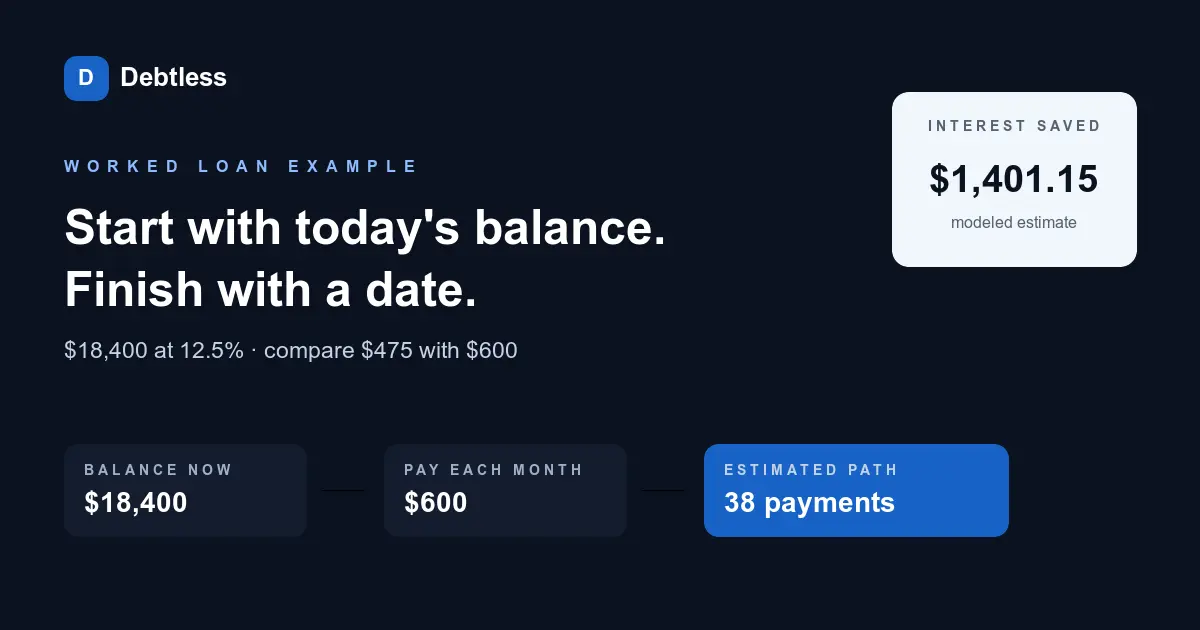
The short answer
To estimate a loan payoff, start with today's principal balance, add the interest that accrues each period, subtract the payment, and repeat until the balance reaches zero. A fixed monthly estimate needs the balance, interest rate, payment amount, and next payment date; an exact final-payment amount still requires a lender quote. For an $18,400 loan at 12.5%, paying $475 a month takes about 50 payments and $5,283.90 in modeled interest.
Which four inputs produce a useful loan payoff estimate?
A useful loan payoff estimate starts with the current principal balance, the rate used to accrue interest, the amount you will pay, and the date or frequency of those payments. Past payments have already changed the original amount borrowed. The current balance is the money still exposed to interest, so it belongs at the top of the calculation.
Take the inputs from the same dated statement when possible. A balance from Monday paired with accrued interest from Friday double-counts some days. If the statement lists APR and an interest rate separately, check the agreement or ask the lender which rate drives account accrual. The CFPB defines APR as a broader borrowing-cost measure that includes the interest rate and certain fees; it is not always the same number used in a daily payoff calculation.
The payment must be large enough to reduce principal after interest. On the example loan, one month's rough interest is $191.67, found by multiplying $18,400 by 12.5% and dividing by 12. A $175 payment would not cover that estimate, so the balance would grow instead of reaching a payoff date.
How do you estimate the payoff month by month?
Estimate the payoff month by adding one period's interest to the balance and then subtracting the planned payment. For monthly planning, use balance times annual rate divided by 12. Carry the result forward and repeat. Stop when the payment is enough to clear the balance plus that period's interest; the last payment will usually be smaller than the normal payment.
The first line of the worked example is $18,400 + $191.67 - $475 = $18,116.67. The next month's interest is calculated on $18,116.67, not the original $18,400. That declining base is why the interest charge falls while more of the same $475 reaches principal.
A spreadsheet can repeat that line, but keep the estimate tied to statements. A payoff plan made from statements explains which figures to refresh when a new bill arrives. If a late fee, skipped payment, rate change, or new advance appears, update the row rather than forcing the old forecast to fit.
| Payment | Interest | Principal reduction | Balance after payment |
|---|---|---|---|
| 1 | $191.67 | $283.33 | $18,116.67 |
| 2 | $188.72 | $286.28 | $17,830.38 |
| 3 | $185.73 | $289.27 | $17,541.11 |
Figures are rounded to cents for display. The full payoff totals below retain unrounded monthly calculations.
What changes when the loan accrues interest every day?
A daily-interest loan needs the number of days between payments, so a monthly model becomes an approximation. Federal Student Aid describes Direct Loans as "daily interest" loans and gives the formula as principal times the interest-rate factor times days since the last payment. Its rate factor uses the annual rate divided by 365.25.
At $18,400 and 12.5%, the approximate daily interest is $6.30. If 17 days pass after the balance date with no payment, that adds about $107.05. A weekend, processing delay, or payment posting during that interval changes the exact result, which is why a dated lender quote matters for the final transfer.
Loan structure matters too. The CFPB says simple interest, calculated from the outstanding balance daily or monthly, is far more common for auto loans than precomputed interest. Under a precomputed contract, sending extra may not reduce the principal and interest in the same way. Loan-type assumptions change an amortization result, so read the agreement before treating a generic estimate as exact.
Why is an estimated payoff different from a payoff quote?
An estimated payoff answers how long a payment pattern may take or roughly how much is due on a future date. Use that estimate for planning. A payoff quote tells you what the lender will accept to close the account on a named date, and it belongs with the final payment.
The distinction is easiest to see on a mortgage. The CFPB says, "Your payoff amount is different from your current balance." It can include interest through the intended payoff day, unpaid fees, and a prepayment penalty when one applies. Other loan contracts can also add daily interest or authorized charges, even when the dashboard displays a round balance.
Request the official quote shortly before payoff and follow its payment instructions. Confirm the good-through date, acceptable payment method, and what happens to a small overpayment. If you are estimating several debts instead of closing one account, the Debtless payoff calculator can compare them under one monthly budget.
Worked example · illustrative numbers
How much does $125 extra change an $18,400 loan?
| Measure | $475 monthly | $600 monthly |
|---|---|---|
| Starting balance | $18,400 | $18,400 |
| Annual rate | 12.5% | 12.5% |
| Estimated payments | 50 | 38 |
| Modeled interest | $5,283.90 | $3,882.74 |
| Modeled total paid | $23,683.90 | $22,282.74 |
| Change | Baseline | 12 payments sooner; $1,401.15 less interest |
Hypothetical declining-balance loan using monthly rate divided by 12. The final payment is smaller; actual daily accrual and fees can change a lender's quote.
Put this into practice with Debtless
Debtless stores the balance, APR, minimum, and due date you enter for each debt, then projects a debt-free date as you change the extra monthly amount. Use that projection to compare a $475 and $600 plan. Keep the lender's statement as the account record and request a payoff quote before the last payment.

Common questions
Can I estimate payoff by dividing the balance by the payment?
Only as a lower-bound shortcut. Dividing ignores interest, so it makes the loan appear to end too soon. A useful estimate adds each period's interest before subtracting the payment.
Should I use APR or the interest rate in a payoff estimate?
Use the rate the contract says applies to the outstanding balance. APR can include fees and may differ from the accrual rate, so ask the lender when the statement does not make the distinction clear.
Why is the last loan payment smaller?
The normal payment can exceed the remaining principal plus accrued interest. A model should stop at the amount actually owed rather than subtracting a full payment and showing a negative balance.
How close is a loan payoff estimate to the final quote?
It can be close when the balance, rate, dates, and fees are current, but it is still not binding. Daily interest, payment posting, late charges, and contract terms can change the final amount.
Sources & further reading
- CFPB: Auto loan key terms
- Federal Student Aid: Interest rates and daily interest formula
- CFPB: Simple vs. precomputed auto-loan interest
- CFPB: Payoff amount vs. current balance
General education for U.S. readers, not individualized financial, legal or tax advice. Examples are hypothetical; lender terms and actual interest calculations can differ. Check your current statements and agreements.
Published by Debtless with AI-assisted drafting. How this journal is made · Suggest a correction