 Debtless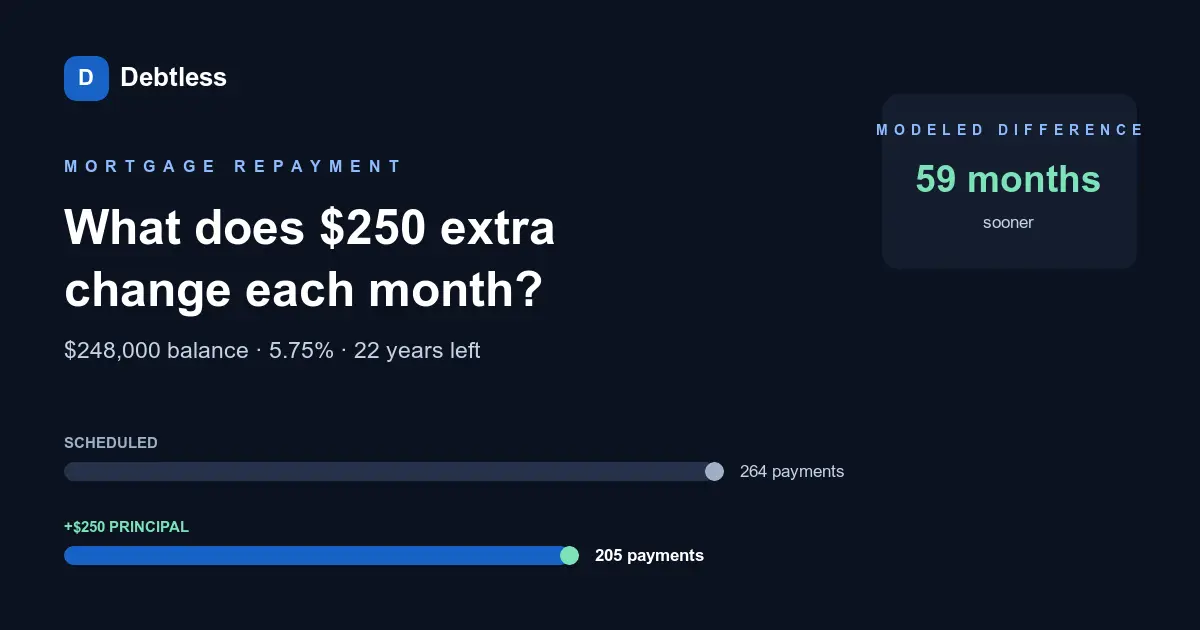
The short answer
A mortgage early repayment calculator estimates how an extra principal payment changes your payoff date and remaining interest. Enter the current principal balance, interest rate, principal-and-interest payment, and a monthly or one-time extra amount; the result compares two modeled paths, while your servicer keeps the official ledger. On a hypothetical $248,000 balance at 5.75% with 22 years left, adding $250 a month cuts the model by 59 payments and about $48,368 in interest.
What does a mortgage early repayment calculator calculate?
A mortgage early repayment calculator runs the remaining loan twice. The baseline uses the current balance, fixed rate, principal-and-interest payment, and payments left. The comparison adds the extra principal you choose. Each month, the model adds interest to the outstanding balance, subtracts the payment, and carries the smaller balance into the next month.
That repeated balance change is amortization. The Consumer Financial Protection Bureau says lenders use a standard formula to set a monthly payment that pays a typical loan off at the end of its term. It also explains that early payments contain more interest because the balance is higher, while later payments send more to principal. An early extra payment therefore removes principal that would otherwise collect interest for many more months.
The calculator should report at least four results: the new payoff month, months removed, interest under each path, and interest saved. A result that shows only a smaller balance after one year leaves out the main reason people run the comparison. Amortization repayment calculators treat different loan types differently, so confirm that the tool assumes the same fixed, declining-balance structure your mortgage uses.
Which numbers should you copy from your mortgage statement?
Copy the current principal balance, note rate, remaining principal-and-interest payment, and remaining term from the latest statement or online account. The current principal reflects payments already made, which makes the original loan amount obsolete for this calculation. Enter the rate printed for this loan; an advertised refinance rate describes a different loan. Count only principal and interest when the calculator asks for the loan payment.
Taxes, homeowners insurance, mortgage insurance, and association dues do not pay down the loan. The CFPB calls principal, interest, taxes, and insurance the four basic elements of a mortgage payment. Principal and interest are the two pieces that repay the mortgage. If the amount withdrawn from your checking account is $2,240 and $582 of it is escrow, enter $1,658 in the calculator's loan-payment field.
Set the extra-payment field to money you can actually repeat. A $3,000 tax refund is a one-time extra, while $250 from each monthly budget is recurring. Combining them into a made-up monthly average can produce a tidy result that does not match when the money reaches the loan.
| Statement item | Use it? | Reason |
|---|---|---|
| Current principal balance | Yes | This is the balance that still earns interest |
| Interest rate | Yes | The model uses it to calculate each month's interest |
| Principal-and-interest payment | Yes | This amount reduces interest and principal |
| Escrow for taxes and insurance | No | Escrow does not reduce mortgage principal |
| Original loan amount | No | Past payments have already reduced it |
Use the latest statement. A calculator built from last year's balance will overstate the time and interest left.
How should you read the baseline and extra-payment results?
Read the baseline first, because it tests the inputs. Its payoff month should be close to the maturity date on your statement. If it is off by years, check whether you entered the total payment instead of principal and interest, used the original balance, or mixed years with months. Fix that mismatch before trusting the extra-payment column.
Then compare the two paths using both time and dollars. The worked example removes 59 monthly payments and $48,368.21 of modeled interest. Those are different benefits: the date shows how long the obligation remains, while interest saved shows the borrowing cost avoided. A household may care more about reaching retirement without a mortgage than maximizing the dollar figure.
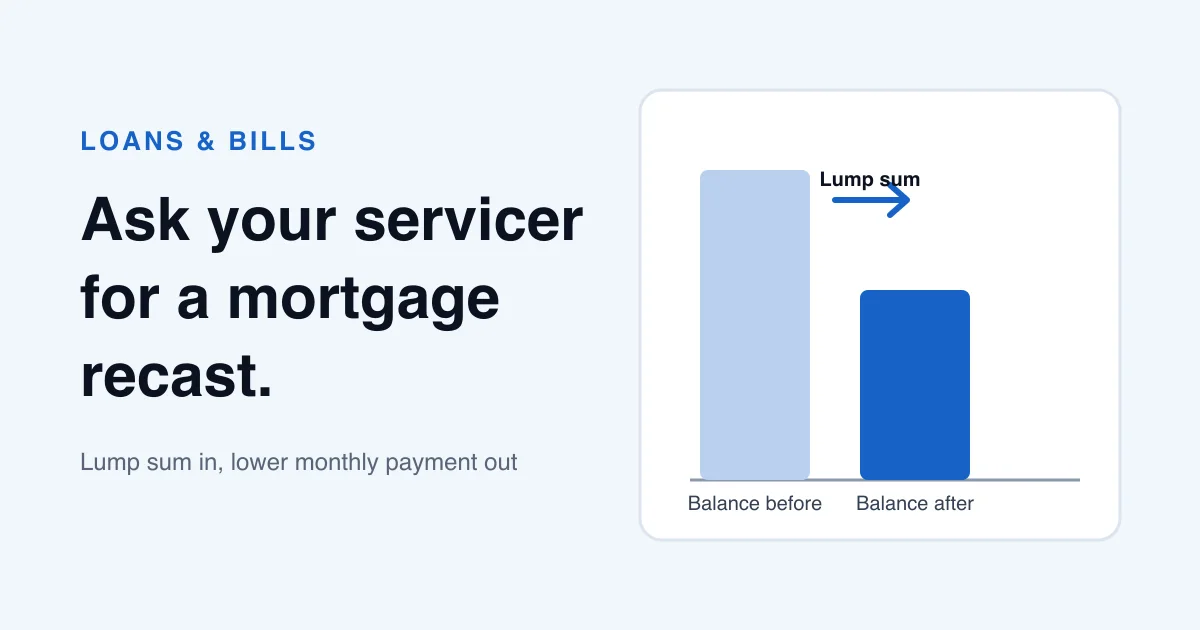
Keep the required payment separate from the amount you plan to send. Extra principal on a standard fixed-rate mortgage usually shortens the loan without lowering next month's required payment. If the goal is a smaller required payment after a lump sum, a mortgage recast follows a different process.
When can the calculator disagree with your servicer?
A mortgage early repayment calculator can disagree with a servicer when the loan is adjustable, payments post on different dates, extra money is not applied to principal, or the agreement includes a prepayment charge. Rounding can also shift the last payment by a few dollars or one month. The model is a planning tool built from assumptions; the servicer controls the account ledger.
Check the agreement and payment instructions before sending a large extra amount. According to the CFPB, a prepayment penalty is a fee some lenders charge when all or part of a mortgage is paid early, although small extra-principal payments do not normally trigger one. The agency still advises borrowers to double-check with the lender.
A payoff projection helps you choose a path. A payoff statement supplies the amount for the final transfer. The CFPB says that statement can include interest through the payoff day and unpaid fees, so it may differ from the displayed balance. Request a dated statement before sending the last payment.
Worked example · illustrative numbers
What does $250 extra do to a $248,000 mortgage?
| Measure | Scheduled path | $250 extra each month |
|---|---|---|
| Starting principal | $248,000 | $248,000 |
| Rate and time left | 5.75%, 22 years | 5.75%, 22 years |
| Monthly principal and interest | $1,657.58 | $1,907.58 |
| Payments until payoff | 264 | 205 |
| Modeled remaining interest | $189,602.24 | $141,234.03 |
| Difference | Baseline | 59 months sooner; $48,368.21 less interest |
Hypothetical fixed-rate loan. Calculations use the exact amortized base payment before display rounding and assume every extra dollar posts to principal with no fee.
Put this into practice with Debtless
Debtless can place this mortgage beside your other balances and compare payoff orders with the same monthly budget. The Debtless payoff calculator models a plan from the balances, APRs, minimums, and extra amount you enter. It does not connect to your servicer or issue an official payoff quote, so reconcile the plan with each new statement.

Common questions
Does paying extra change my required mortgage payment?
Usually no. Extra principal shortens a standard fixed-rate mortgage and reduces future interest, while the scheduled principal-and-interest payment stays the same. A lender-approved recast is the separate process that may lower the required payment.
Should I enter my mortgage balance or payoff amount?
Use the current principal balance to model future monthly payments. Use a dated payoff amount only when you are preparing to satisfy the loan in full, because that quote can include daily interest and fees through a specific date.
Does an early repayment calculator include escrow?
It should not treat escrow as a loan payment. Property taxes, homeowners insurance, and mortgage insurance can be part of the total amount you send, but they do not reduce principal.
Can I model one lump sum instead of a monthly extra payment?
Yes, if the calculator has a dated one-time-payment field. Enter the lump sum in the month you expect it to post rather than spreading it into a monthly average.
Sources & further reading
- CFPB: How does paying down a mortgage work?
- CFPB: What is PITI?
- CFPB: What is a prepayment penalty?
- CFPB: Payoff amount vs. current balance
General education for U.S. readers, not individualized financial, legal or tax advice. Examples are hypothetical; lender terms and actual interest calculations can differ. Check your current statements and agreements.
Published by Debtless with AI-assisted drafting. How this journal is made · Suggest a correction