 Debtless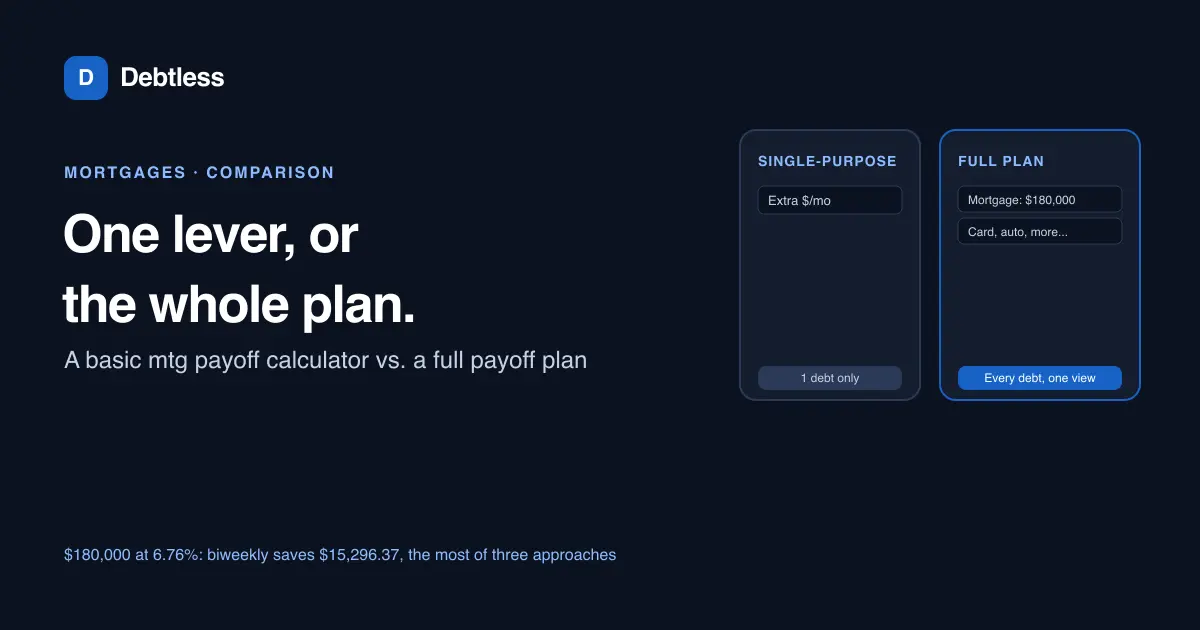
The short answer
Search "mtg payoff calculator" and most results are single-purpose tools: one field for an extra monthly payment, another for a one-time lump sum, sometimes a separate calculator entirely for biweekly schedules. A full payoff plan runs all three against the same balance at once and tracks the mortgage alongside every other debt you owe. On a $180,000 balance at 6.76% with 15 years left, the three approaches save between $8,457.14 and $15,296.37 in interest, different enough that which calculator you use actually changes the answer.
Why "mtg payoff calculator" mostly returns single-purpose tools
Type "mtg payoff calculator" into a search bar and the results split into narrow tools. Bankrate's Additional Payment Calculator, for example, takes an original loan amount, an additional payment amount and a rate, then shows how that one extra payment changes the payoff date and total interest. It doesn't model a lump sum or a biweekly schedule in the same tool.
Other calculators specialize the other way, built around biweekly schedules or a one-time lump sum specifically. Each does its one job accurately, but comparing three approaches on the same loan means running the same balance through three different calculators and lining up the results yourself.
What a full payoff plan adds
A full payoff plan, the kind built into Debtless's payoff calculator, takes the same balance, rate and term and lets you test an extra monthly payment, a lump sum, or both against each other without switching tools. The mortgage also sits next to every other debt you owe, so the extra dollars you're deciding whether to send to the mortgage are visible against what a card balance or a car loan would do with the same money.
That last part is where a single-purpose calculator runs out of scope by design. It can tell you what $100 a month does to a $180,000 mortgage. It can't tell you whether that same $100 would clear a higher-rate credit card faster, since it was never built to hold more than one debt.
Worked example: $180,000 at 6.76% with 15 years left, three ways
Freddie Mac's Primary Mortgage Market Survey put the 30-year fixed rate at 6.76% for the week of September 10, 2026. Take a $180,000 balance at that rate with 180 months, 15 years, remaining. The required payment is $1,593.84 a month, and paying only that amount costs $106,890.33 in total interest.
- Extra $100 a month: payoff in 163 months, about 13 years and 7 months, total interest $95,265.18, a savings of $11,625.15.
- A $5,000 lump sum applied once, then the same required payment continues: payoff in 172 months, about 14 years and 4 months, total interest $98,433.19, a savings of $8,457.14.
- A biweekly schedule, half the payment every two weeks: payoff in about 13 years and 1 month, total interest $91,593.96, a savings of $15,296.37.
Which calculator to reach for
Mortgage balances nationwide totaled $13.1 trillion at the end of the second quarter of 2026, according to the Federal Reserve Bank of New York, which is part of why small differences between calculator approaches add up across so many loans. If you already know which single lever you're pulling, extra monthly payment, lump sum, or biweekly, a single-purpose calculator like Bankrate's is fast and accurate for that one scenario. There's no real advantage to a fuller tool if you've already decided.
A full plan earns its keep when you haven't decided, or when the mortgage is competing with other debt for the same extra dollars. Home Loan Payoff Calculator: A 6-Point Checklist covers the accuracy checks worth running before trusting any calculator's numbers, single-purpose or full plan.
$180,000 balance, 6.76% APR, 15 years remaining
| Required only | +$100/month | $5,000 lump sum | Biweekly | |
|---|---|---|---|---|
| Time to payoff | 15 years | 13 years, 7 months | 14 years, 4 months | 13 years, 1 month |
| Total interest | $106,890.33 | $95,265.18 | $98,433.19 | $91,593.96 |
| Interest saved | $0.00 | $11,625.15 | $8,457.14 | $15,296.37 |
Calculated with the standard amortization formula; the biweekly scenario simulates 26 half-payments a year. Rate reflects Freddie Mac's Primary Mortgage Market Survey average for the week of September 10, 2026.
Worked example · illustrative numbers
Example: why biweekly won by more than the $100-a-month plan
On this $180,000 balance, a biweekly schedule saved $15,296.37, more than either the $100-a-month extra payment ($11,625.15 saved) or the $5,000 lump sum ($8,457.14 saved).
The difference comes down to how much extra actually gets applied each year. The biweekly schedule adds one full extra payment annually, $1,593.84, more than the $100-a-month plan's $1,200 a year, which is why it saves more despite feeling like a scheduling change rather than a budget increase.
Put this into practice with Debtless
Debtless doesn't have a separate mortgage calculator, a biweekly calculator and a lump-sum calculator. One payoff calculator takes your mortgage's balance, rate, remaining term and any extra payment, monthly or one-time, and shows the new payoff date next to every other debt in the free iPhone app, so the mortgage isn't the only number you're deciding around.

Common questions
Does "mtg payoff calculator" mean something different from "mortgage payoff calculator"?
No, "mtg" is just the common abbreviation for mortgage that shows up in search bars and loan documents. The calculators behind both searches are the same tools.
Which saves more: an extra monthly payment, a lump sum, or biweekly payments?
It depends on the amounts involved, but in this $180,000 example, biweekly saved the most, $15,296.37, because it effectively adds one extra full payment a year, more than the other two scenarios contributed annually.
Can one calculator model all three approaches at once?
Most single-purpose calculators, including Bankrate's Additional Payment Calculator, handle one approach at a time. A full payoff plan tests more than one against the same balance, and shows it next to every other debt you owe.
Should I use a single-purpose calculator or a full payoff plan?
A single-purpose calculator is enough if you already know which approach you're using. A full plan is more useful if you're still deciding, or if the mortgage is one of several debts competing for the same extra dollars.
Sources & further reading
- Bankrate: Additional Payment Calculator
- Freddie Mac: Primary Mortgage Market Survey
- Federal Reserve Bank of New York: Household Debt and Credit Report, Q2 2026
General education for U.S. readers, not individualized financial, legal or tax advice. Examples are hypothetical; lender terms and actual interest calculations can differ. Check your current statements and agreements.
Published by Debtless with AI-assisted drafting. How this journal is made · Suggest a correction