 Debtless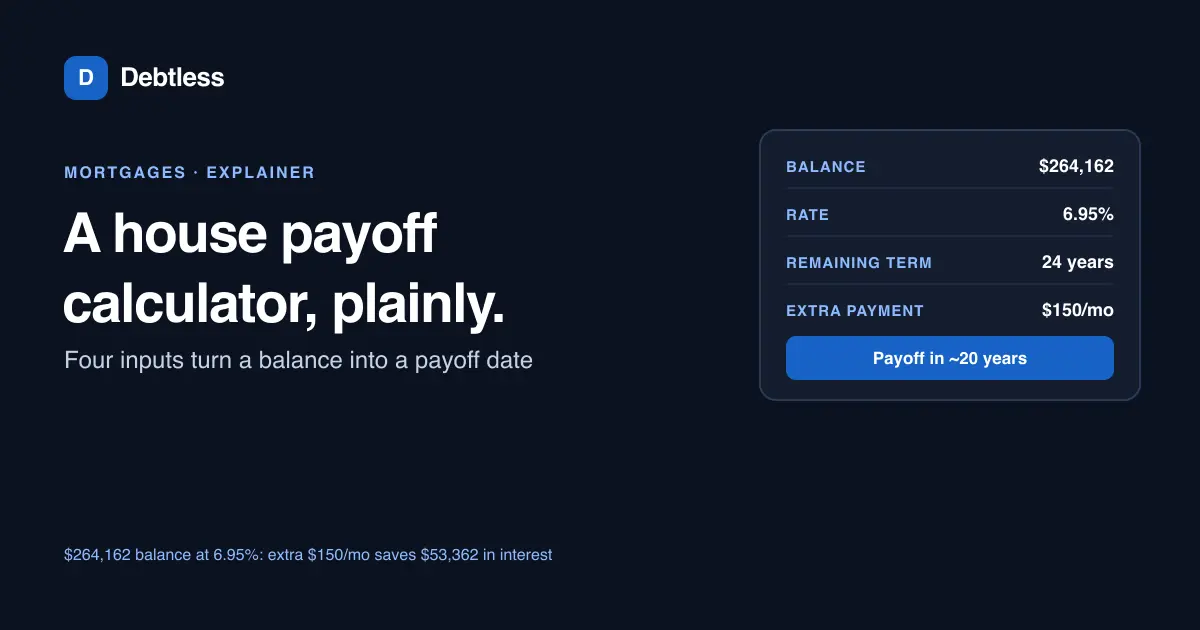
The short answer
A house payoff calculator takes four numbers you already have, your current mortgage balance, your interest rate, how many months are left on the loan, and any extra amount you plan to pay, and turns them into a new payoff date. It's a different tool than the calculator you used to shop for the loan, since that one solves for a monthly payment on money you haven't borrowed yet. On a $264,162 balance at 6.95% with 24 years left, an extra $150 a month moves the payoff date almost 4 years earlier and cuts about $53,362 in interest.
Why a payoff calculator is a different tool than a payment calculator
A mortgage payment calculator answers a shopping question: if I borrow this much at this rate for this term, what's the monthly payment. A house payoff calculator answers a different question about a loan you already have: given what I owe right now, how fast can that balance reach zero.
The two tools share the same amortization math underneath, but they start from different places. A payment calculator starts from a home price and a down payment. A payoff calculator starts from your current statement.
You'll want the payment calculator before you sign anything, to compare offers and terms. You'll want the payoff calculator any time after that, whenever you're deciding whether an extra payment, a bonus, or a change in your budget is worth putting toward the mortgage instead of somewhere else.
The four inputs, in plain English
Every house payoff calculator, including the one built into Debtless, needs the same four pieces of information. Get any one of them wrong and the payoff date it shows won't match reality.
- Current balance: the amount you still owe today, from your most recent statement, not the amount you originally borrowed.
- Interest rate: the rate on your loan right now. If it's an adjustable-rate mortgage, use the rate after any reset, not the original rate.
- Remaining term: how many months are actually left on the loan, not the original 15- or 30-year term you started with.
- Extra payment: any amount above the required payment you plan to add each month, entered as an extra principal payment rather than folded into the regular payment.
Where the average mortgage balance fits in
The average American carried $264,162 in mortgage debt as of March 2026, according to Experian, up from the prior year. That figure is useful mostly as a sanity check: if your own balance is in a similar range, the kind of extra-payment math below applies to you almost exactly as written.
Total U.S. mortgage debt stood at $13.117 trillion in the second quarter of 2026, according to the Federal Reserve, the largest single category of household debt by a wide margin. None of that changes how your own calculator works, since it only needs your balance, not the national one.
Reading the calculator's output correctly
A payoff calculator's main output is a date and a total-interest figure, sometimes shown as a comparison between your required payment and a payment with extra added. The date moves earlier as the extra amount goes up, but not in a straight line, since the biggest interest savings come from extra principal paid early in the remaining term.
Home Loan Payoff Calculator: A 6-Point Checklist covers the accuracy details worth confirming before you trust a specific date, like whether your servicer applies extra payments to principal immediately.
$264,162 balance, 6.95% APR, 24 years remaining
| Required payment only | With extra $150/month | |
|---|---|---|
| Monthly payment | $1,887.73 | $2,037.73 |
| Months to payoff | 288 | 241 |
| Time to payoff | 24 years | About 20 years |
| Total interest paid | $279,503.08 | $226,141.32 |
Calculated with the standard amortization formula. Rate reflects Freddie Mac's Primary Mortgage Market Survey average for the week of September 17, 2026.
Worked example · illustrative numbers
Example: what $150 a month actually buys
Take a $264,162 balance at 6.95% APR with 288 months (24 years) remaining. The required payment on that schedule is $1,887.73, and paying only that amount costs $279,503.08 in total interest over the full remaining term.
Add $150 a month in extra principal and the loan is paid off in 241 months, about 20 years, roughly 3 years and 11 months sooner. Total interest drops to $226,141.32, a savings of $53,361.76, all from one consistent extra payment applied every month without interruption.
Put this into practice with Debtless
Debtless doesn't pull your mortgage balance from your bank, since it doesn't connect to any accounts. Enter your current balance, rate, remaining term and any extra payment, and the free iPhone app's payoff calculator shows your new debt-free date alongside every other debt you're tracking, not just the mortgage.

Common questions
What's the difference between a payoff calculator and a payment calculator?
A payment calculator estimates the monthly payment on a loan you haven't taken out yet, using a home price and down payment. A payoff calculator starts from a loan you already have and estimates how fast your current balance reaches zero.
Do I need my original loan term or my remaining term?
Use your remaining term. If you're five years into a 30-year mortgage, enter 25 years, not 30. Using the original term will make the calculator understate how close you actually are to being done.
Does a house payoff calculator account for property taxes and insurance?
No, it typically only works with the loan balance itself, not escrowed taxes or insurance. Keep those out of the balance and payment figures you enter, since folding them in will distort the payoff date and make the interest-savings math harder to trust.
Can I check a payoff calculator's math before trusting it with my real numbers?
Yes. [Run it against a simple example you can verify by hand first](/blog/test-debt-app-calculator/), using a round balance and a rate you can check with any calculator app. If it matches what you'd expect, the same math applies to your real balance.
Sources & further reading
- Experian: Average U.S. mortgage debt, March 2026
- Federal Reserve Bank of New York: Household Debt and Credit Report, Q2 2026
- Freddie Mac: Primary Mortgage Market Survey
General education for U.S. readers, not individualized financial, legal or tax advice. Examples are hypothetical; lender terms and actual interest calculations can differ. Check your current statements and agreements.
Published by Debtless with AI-assisted drafting. How this journal is made · Suggest a correction