 Debtless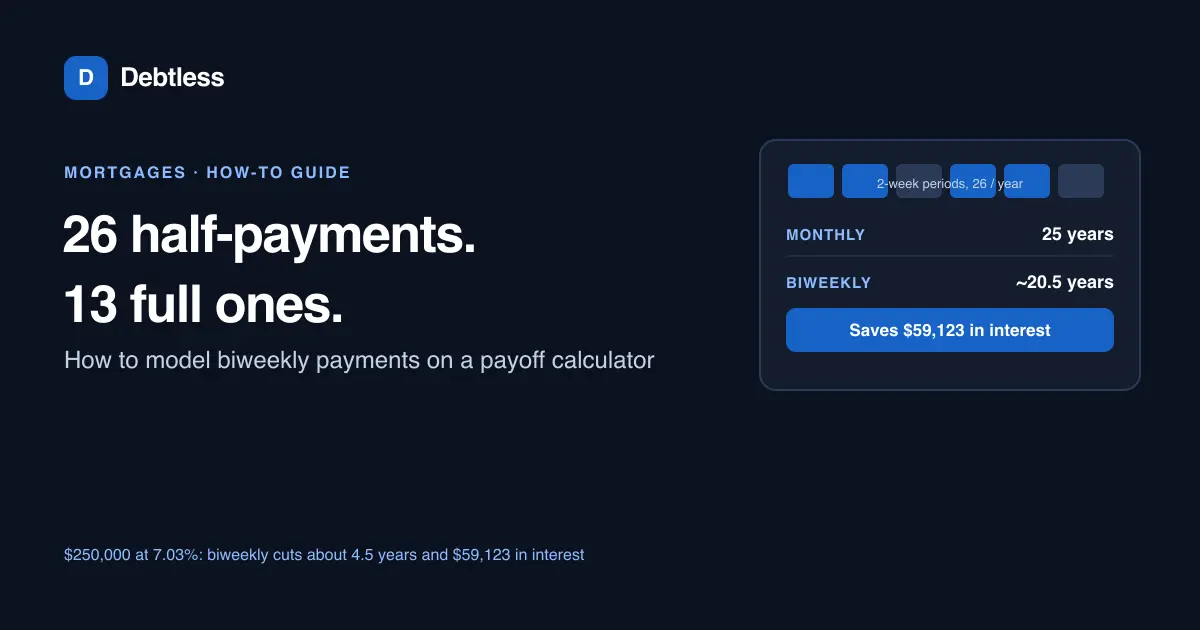
The short answer
To run a biweekly payment through a mortgage payoff calculator, split your normal monthly payment in half and treat the result as an extra payment made every two weeks instead of once a month. That schedule produces 26 half-payments a year, the equivalent of 13 full monthly payments instead of 12, and the extra payment goes straight to principal. On a $250,000 balance at 7.03% with 25 years left, switching to biweekly cuts the loan to about 20 years and 6 months and saves roughly $59,123 in interest.
Why a biweekly schedule shortens a mortgage
A biweekly schedule doesn't lower your interest rate or change your loan terms. It works because paying every two weeks produces 26 payments a year instead of 12 monthly payments, and 26 half-payments equal 13 full monthly payments, one more than a standard schedule makes.
That extra payment goes entirely to principal, and a smaller principal balance means less interest accrues starting the next day. Bankrate's own example shows the size of the effect: a $410,000 home financed at 6.4% over 30 years pays $461,922 in total interest on a monthly schedule, but $353,621 on a biweekly schedule, a savings of more than $108,000, finishing in about 24 years instead of 30.
How to set it up on a payoff calculator
Most payoff calculators, including Debtless's, don't have a dedicated biweekly button. You can still model the exact effect using the extra-payment field almost every calculator already has.
- Find your current required monthly payment, either from your statement or by running your balance, rate and remaining term through the calculator once.
- Divide that payment by 12, then multiply by 13 to find your new effective annual payment total, and figure out how much extra that adds to your monthly amount.
- Enter that difference as an extra monthly payment rather than trying to enter a biweekly schedule directly, since most calculators expect monthly inputs.
- Confirm with your servicer that any automated biweekly plan applies each half-payment to principal right away, and doesn't just hold the money until it equals a full payment.
Worked example: $250,000 at 7.03% with 25 years left
Take a $250,000 balance at 7.03%, Freddie Mac's 30-year average for the week of September 24, 2026, with 300 months, 25 years, remaining. The required monthly payment on that schedule is $1,771.74, and paying only that amount costs $281,520.60 in total interest.
Switching to a biweekly schedule means paying $885.87 every two weeks, 26 times a year. Run the loan on that schedule and it pays off in 534 biweekly periods, about 20 years and 6 months, roughly 4 years and 6 months sooner. Total interest drops to $222,398.00, a savings of $59,122.61.
Watch for a fee before you sign up for an official biweekly plan
Some servicers offer a formal biweekly payment program, and some charge a setup or ongoing fee for it. You can get the identical result for free by simply making one extra full payment a year on your own, applied to principal, or by adding one-twelfth of a payment to every monthly bill.
Home Loan Payoff Calculator: A 6-Point Checklist covers the same confirmation step either way: check that extra amounts post to principal immediately, since that's what makes the early-payoff math work.
Comparing biweekly against a plain monthly extra payment
A biweekly schedule and a monthly extra payment can land in a similar place if the total extra dollars per year are close. Online Mortgage Payment Calculator: A Step-by-Step Guide walks through how a calculator prices the base payment before extra payments of any kind enter the picture.
Once you know which approach fits your pay schedule, entering the balance, rate and extra amount into Debtless's payoff calculator shows the new date next to every other debt you're tracking, not the mortgage in isolation.
$250,000 balance, 7.03% APR, 25 years remaining
| Standard monthly | Biweekly | |
|---|---|---|
| Payment | $1,771.74/month | $885.87 every 2 weeks |
| Time to payoff | 25 years | About 20 years, 6 months |
| Total interest paid | $281,520.60 | $222,398.00 |
Calculated by simulating 26 biweekly periods per year against the standard amortization formula on a $250,000 balance at 7.03% APR.
Worked example · illustrative numbers
Example: Bankrate's $410,000 comparison, for scale
Bankrate's own worked example uses a larger loan: $410,000 financed at 6.4% over 30 years, with a $2,308 monthly payment. On a standard monthly schedule, that loan costs $461,922 in total interest. On a biweekly schedule, it costs $353,621, a savings of $108,301, and it finishes in about 24 years instead of 30.
The dollar amounts scale with the loan size, but the mechanism is identical to the $250,000 example above: one extra full payment a year, applied to principal, compounding into a shorter loan and less total interest.
Put this into practice with Debtless
Debtless doesn't set up an automated biweekly draft from your bank, since it doesn't connect to any accounts. Enter your mortgage's balance, rate and the extra monthly amount that matches a biweekly schedule, and the free iPhone app's payoff calculator shows the new payoff date alongside every other debt you're tracking.

Common questions
Does a biweekly mortgage payment actually save money, or is it a gimmick?
It saves real money, because it produces 13 full monthly payments a year instead of 12, with the extra amount applied to principal. Bankrate's example shows over $108,000 saved on a $410,000 loan; the size of the savings scales with your own balance and rate.
How do I model biweekly payments if my calculator only takes monthly inputs?
Add the equivalent extra monthly amount instead of entering a true biweekly schedule. Dividing your annual extra payment (one full monthly payment) by 12 gives you the number to enter in a standard extra-payment field.
Should I pay a servicer's fee for an official biweekly program?
Usually not necessary. You can get the same result by making one extra full principal payment a year on your own schedule, or by adding one-twelfth of a payment to each monthly bill, with no fee.
Can Debtless calculate a biweekly mortgage payoff automatically?
Debtless doesn't have a dedicated biweekly toggle, but [its payoff calculator](/debt-payoff-calculator/) accepts an extra monthly payment, which is enough to model the identical effect once you've converted the biweekly amount to a monthly equivalent.
Sources & further reading
General education for U.S. readers, not individualized financial, legal or tax advice. Examples are hypothetical; lender terms and actual interest calculations can differ. Check your current statements and agreements.
Published by Debtless with AI-assisted drafting. How this journal is made · Suggest a correction