 Debtless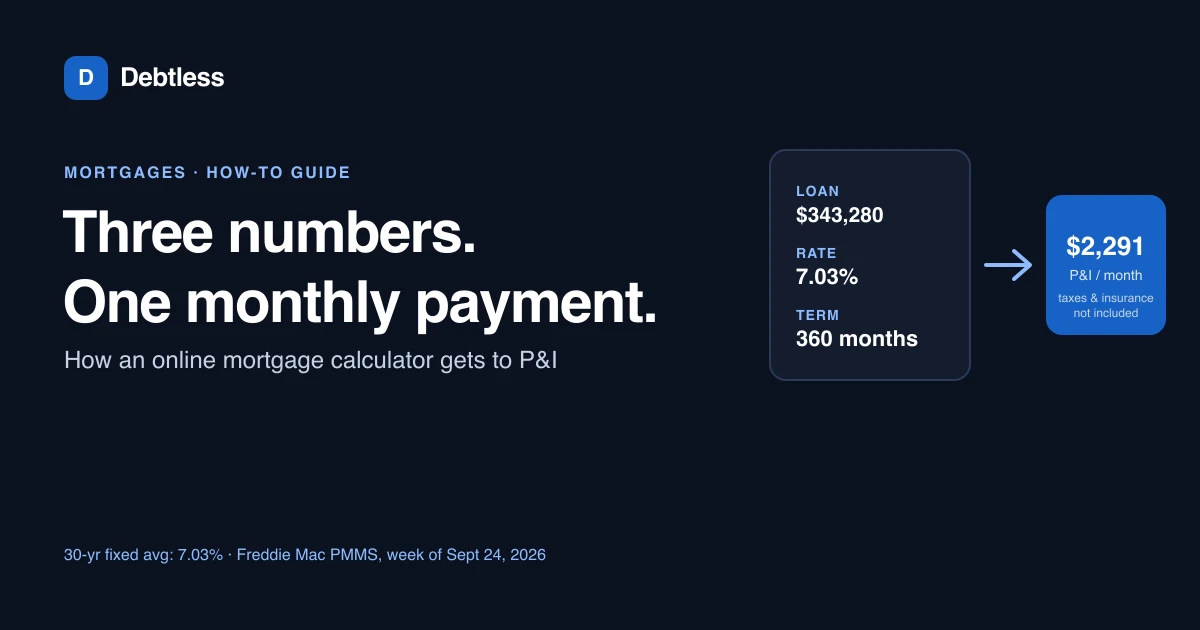
The short answer
An online mortgage payment calculator estimates your monthly principal-and-interest payment from three numbers: how much you're borrowing, your interest rate, and your loan term. Enter a $343,280 loan at 7.03%, the average 30-year rate Freddie Mac reported for the week of September 24, 2026, over 360 months, and it returns about $2,291 a month. That figure is usually lower than what you'll actually owe each month, since most calculators skip property taxes, homeowners insurance and mortgage insurance entirely.
The three numbers a mortgage calculator needs
A basic mortgage payment calculator needs a loan amount, an interest rate, and a term in months, the same three inputs an auto loan calculator uses, run through the same amortization formula. The loan amount is your home price minus your down payment, not the purchase price itself.
The national median existing-home price was $429,100 in August 2026, up 1.6% from $422,400 a year earlier, according to the National Association of Realtors. Freddie Mac's Primary Mortgage Market Survey put the average 30-year fixed rate at 7.03% for the week of September 24, 2026, up from 6.95% the week before; its 15-year fixed average was 6.42%, up from 6.26%.
Step by step: pricing a $429,100 home
Here's how those numbers turn into a payment on the median-priced home NAR reported for August 2026, assuming a 20% down payment.
- Subtract your down payment from the home price. On $429,100 with 20% down ($85,820), the loan amount is $343,280.
- Enter the interest rate you were actually quoted, or a current average like Freddie Mac's 7.03%, if you're just estimating.
- Enter the term in months: 360 for a 30-year fixed loan, 180 for a 15-year.
- Read the output as principal and interest only. On this example, that's about $2,290.77 a month at 7.03% over 360 months.
- Add your own estimates for property taxes, homeowners insurance, and mortgage insurance if your down payment is under 20%, since the P&I figure alone isn't your full monthly cost.
Why the calculator's number and your Loan Estimate won't match
According to the Consumer Financial Protection Bureau, your total monthly mortgage payment usually includes more than principal and interest: homeowners insurance, property taxes, and possibly mortgage insurance, on top of the loan payment itself. Many buyers who focus only on the principal-and-interest figure get an unpleasant surprise when their actual monthly cost turns out to be substantially higher.
A calculator that only asks for loan amount, rate and term is doing P&I math correctly; it's just not answering the full-cost question. Check the projected payment on your actual Loan Estimate document instead of a calculator's output before you decide what you can afford.
Comparing a 15-year term against a 30-year term
Running the same $343,280 loan at a 15-year term, using Freddie Mac's 6.42% average for that product, produces a payment of about $2,975.26 a month, roughly $685 more than the 30-year option. The tradeoff shows up over the life of the loan: the 30-year loan totals about $481,398 in interest, while the 15-year loan totals about $192,267, a difference of roughly $289,000 for a monthly payment that's about 30% higher.
Amortization explains why the split between principal and interest changes so much between these two terms, even though both are fixed-rate loans on the same amount.
Using the calculator's output as a starting point
A calculator's principal-and-interest figure is the right first number to know, but it's a starting point for shopping, not a finished budget. How lenders apply payments covers the order fees, interest and principal are satisfied in once you're making real payments, which matters just as much for a mortgage as it does for a car loan or a card minimum payment.
Once you know your mortgage's balance, rate and payment, Debtless's payoff calculator can include it alongside any other debt you're tracking, so you see the whole picture rather than one loan in isolation.
$343,280 loan: 30-year vs. 15-year term
| 30-year fixed | 15-year fixed | |
|---|---|---|
| Rate used | 7.03% | 6.42% |
| Monthly P&I payment | $2,290.77 | $2,975.26 |
| Total interest paid | $481,397.54 | $192,266.97 |
Rates from Freddie Mac's Primary Mortgage Market Survey, week of September 24, 2026. Payments calculated with the standard amortization formula.
Worked example · illustrative numbers
Example: what the first year of payments covers
On the $343,280 loan at 7.03% over 360 months, the first 12 monthly payments of $2,290.77 add up to $27,489.25. Run the amortization schedule and only about $3,466.96 of that reduced the loan balance.
The remaining $24,022.29 covered interest, which is typical for the first year of a 30-year mortgage at a rate above 7%. That ratio shifts toward principal every year that follows, which is why extra payments made early in a mortgage save more total interest than the same extra payment made later.
Put this into practice with Debtless
Debtless doesn't price mortgages or estimate a payment before you apply; a lender's calculator or Freddie Mac's published rates are the right stop for that. Once you have the loan, enter its balance, rate and minimum payment into the free iPhone app, and the payoff calculator shows how extra payments change your other debt-free dates alongside it.

Common questions
What does an online mortgage payment calculator actually calculate?
Most calculate principal and interest only, from your loan amount, interest rate and term in months, using standard amortization math. They typically don't include property taxes, homeowners insurance or mortgage insurance unless you enter those separately.
Why is my quoted payment higher than the calculator showed?
Your total monthly payment usually includes taxes, insurance and possibly mortgage insurance on top of principal and interest, according to the CFPB. Check your Loan Estimate's full projected payment rather than a bare P&I calculator result.
Is a 15-year mortgage always better than a 30-year one?
Not automatically. A 15-year loan usually carries a lower rate and far less total interest, but a noticeably higher monthly payment. Whether that tradeoff fits depends on your monthly budget, not just the total-interest comparison.
Can Debtless calculate a mortgage payment before I apply for a loan?
No, a lender's or a dedicated mortgage calculator is the right tool for pricing a loan before you apply. Once you have the mortgage, enter its balance, rate and payment into [Debtless's payoff calculator](/debt-payoff-calculator/) alongside your other debts to see how it fits into a full plan.
Sources & further reading
- Freddie Mac: Primary Mortgage Market Survey
- NAR: Existing-Home Sales Report, August 2026
- CFPB: Principal and interest versus total mortgage payment
General education for U.S. readers, not individualized financial, legal or tax advice. Examples are hypothetical; lender terms and actual interest calculations can differ. Check your current statements and agreements.
Published by Debtless with AI-assisted drafting. How this journal is made · Suggest a correction