 Debtless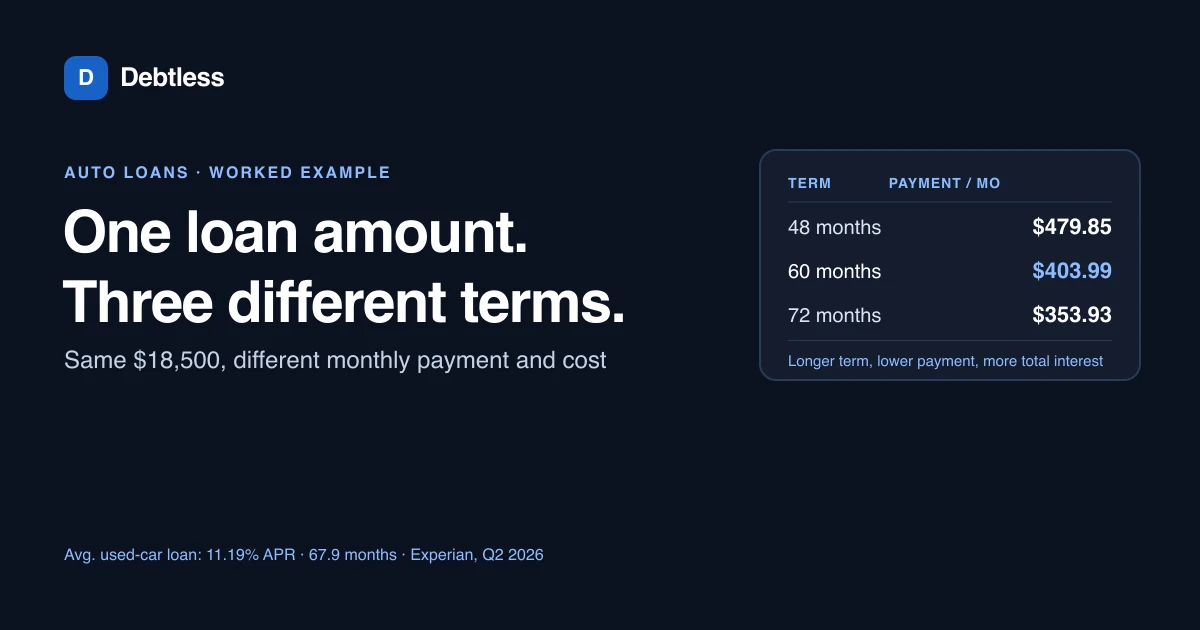
The short answer
A car payment calculator, whether it's Bankrate's, a dealer's, or the one built into Debtless, turns three inputs (the amount financed, the APR, and the term in months) into one fixed monthly payment. Enter $18,500 financed at 11.19% APR over 60 months and it returns $403.99, using the same amortization formula every version of the tool runs. What it won't show you is how much of that $403.99 fights interest in the first year, or how the total cost changes if you pick a different term.
The three inputs behind every car payment calculator
Type an amount financed, an APR and a term into any car payment calculator and it solves the same equation: monthly payment equals the loan amount times the monthly interest rate, divided by 1 minus (1 plus the monthly rate) raised to the negative number of payments. That's standard loan amortization, and it doesn't change whether the calculator has a bank's logo on it or a dealer's.
The averages behind those three inputs moved in 2026. The average new-car loan ran $765 a month at 6.35% APR over 69.5 months in the second quarter, while the average used-car loan ran $542 a month at 11.19% APR over 67.9 months, according to Experian's State of the Automotive Finance Market report. Used-car buyers pay a noticeably higher rate for a similar term, which is worth knowing before you assume your quote is out of line.
Worked example: $18,500 at 11.19% APR over 60 months
Say you're financing a used car: $18,500 at 11.19% APR, on a 60-month term close to the Experian average. Run the numbers and the calculator returns $403.99 a month. That's the number that goes on a truth-in-lending disclosure and the number a lender expects on the first of the month.
You can check any calculator's output by running the same four steps yourself, or by comparing two different calculators against the same inputs.
- Confirm the amount financed matches your offer, not the sticker price. Taxes, fees or an extended warranty rolled in will raise this number.
- Confirm the APR is the one on your actual offer, not an advertised "as low as" rate that assumes top-tier credit.
- Enter the term in months (60, not 5 years) since most calculators expect a monthly count.
- Compare the result to your written offer. A mismatch usually means one of the three inputs above doesn't match what you were actually quoted.
What changes when you stretch or shorten the term
The same $18,500 at 11.19% APR produces a different payment, and a very different total cost, depending on the term you choose. A calculator will happily solve for whichever term gives you the payment you want, but a lower monthly number on a longer term isn't free.
What the monthly number doesn't show you
A car payment calculator gives you one static figure: the payment. It doesn't show where that payment goes each month. Early in the loan, a larger share of every payment covers interest rather than principal, the same structure used on mortgages and most other installment loans, so the balance falls more slowly than the payment amount alone suggests.
On the $18,500 loan above, the first 12 months of $403.99 payments add up to $4,847.88 paid. Of that, only about $2,924.72 actually reduced the balance; the remaining $1,923.16 covered interest. How lenders apply payments covers the order fees, interest and principal get satisfied in, and amortization explains why early payments behave this way on any installment loan, car or otherwise.
Turning the payment number into a full payoff plan
A car payment calculator answers one question: can you afford this monthly payment. It doesn't say anything about the credit card balance or personal loan you're carrying alongside it, or whether extra money is better spent on the car loan or somewhere with a higher rate. Bankrate Auto Payment Calculator vs. a Full Payoff Plan goes further into that gap.
Once you know the car loan's balance, APR and minimum payment, Debtless's payoff calculator compares snowball, avalanche and cash-flow order across everything you owe, car loan included, instead of solving for one loan in isolation.
$18,500 at 11.19% APR: same loan, three terms
| Term | Monthly payment | Total interest paid |
|---|---|---|
| 48 months | $479.85 | $4,532.85 |
| 60 months | $403.99 | $5,739.40 |
| 72 months | $353.93 | $6,983.21 |
Figures calculated with the standard amortization formula on $18,500 financed at 11.19% APR, the average used-car rate Experian reported for Q2 2026.
Worked example · illustrative numbers
Example: where the first year of payments actually goes
Take the $18,500 loan at 11.19% APR over 60 months, with a $403.99 monthly payment. After 12 payments, you've paid $4,847.88 in total. Run the amortization schedule and the balance has only dropped to about $15,575.28, a reduction of $2,924.72.
The other $1,923.16 covered interest on the still-large balance. That split shifts in your favor every month as the balance shrinks, but it starts out lopsided on any loan with a double-digit APR, which is the part a single monthly-payment number doesn't communicate.
Put this into practice with Debtless
Debtless doesn't estimate a car payment before you sign; a payment calculator is the right tool for that step. Once you have the loan, enter its balance, APR and minimum payment into the free iPhone app alongside everything else you owe, and the payoff calculator shows how extra payments and payoff order change your debt-free date.

Common questions
Is a car payment calculator's estimate accurate?
Yes, for the number it's built to produce: a fixed monthly payment from an amount financed, an APR and a term, using standard amortization math. Any calculator using the same three inputs and formula returns the same payment.
Why does my real payment differ from the calculator's number?
Usually one of the three inputs doesn't match your actual offer. Taxes, fees or an add-on like an extended warranty rolled into the amount financed, or an advertised rate that differs from the APR on your specific offer, are the most common causes.
Does a longer loan term always cost more overall?
At the same rate, yes. A longer term lowers the monthly payment but increases total interest paid, since you're borrowing the same amount for more months. On the $18,500 example here, going from 60 to 72 months adds $1,243.81 in total interest for a $50 lower payment.
Can Debtless calculate my car payment the way a lender's calculator does?
Debtless doesn't originate loans or estimate a payment before you sign; a dedicated payment calculator is the right stop for that. Once you have the loan, enter its balance, APR and minimum payment into [Debtless's payoff calculator](/debt-payoff-calculator/) alongside your other debts to see how it fits into a full plan.
Sources & further reading
General education for U.S. readers, not individualized financial, legal or tax advice. Examples are hypothetical; lender terms and actual interest calculations can differ. Check your current statements and agreements.
Published by Debtless with AI-assisted drafting. How this journal is made · Suggest a correction