 Debtless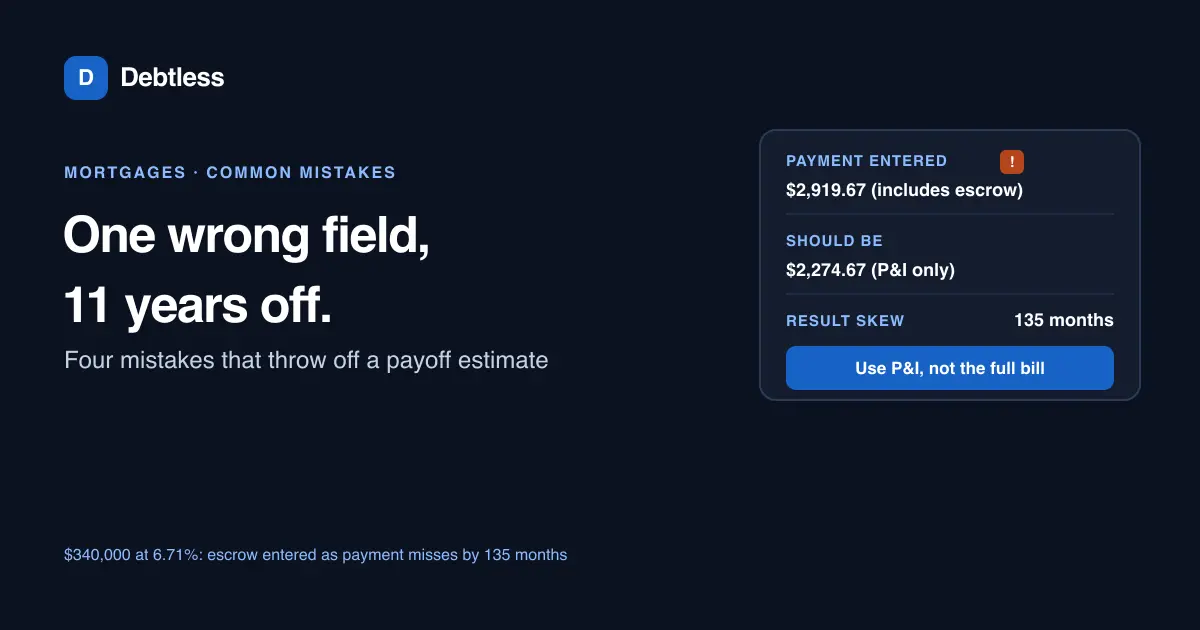
The short answer
A mortgage payoff estimator gives you a payoff date and an interest total based on exactly four numbers: your balance, rate, remaining term and extra payment. The most common mistake is entering your total mortgage bill, including escrow for taxes and insurance, as if it were the principal-and-interest payment the estimator actually needs. On a $340,000 balance at 6.71%, that single mix-up can make an estimator show a payoff 135 months early, a difference of more than 11 years that isn't real.
Mistake 1: entering your total payment instead of principal and interest
Most mortgage bills bundle several things into one number: principal, interest, and an escrow portion for property taxes and homeowners insurance. According to the Consumer Financial Protection Bureau, an escrow account lets a lender collect and manage funds for those recurring property costs as part of the monthly bill, so the figure on your statement is rarely just principal and interest.
A payoff estimator needs the principal-and-interest piece specifically, since escrow money doesn't reduce the loan balance at all. On a $340,000 balance at 6.71% with 27 years, 324 months, remaining, the true required principal-and-interest payment is $2,274.67. Add a typical $645 monthly escrow portion and the total bill comes to $2,919.67.
Enter that full $2,919.67 as if it were the principal-and-interest payment, and an estimator built for a $340,000 balance at 6.71% reports a payoff in 189 months, about 15 years and 9 months, saving what looks like 135 months against the true 324-month schedule. None of those extra months are real. The estimator just thinks a much bigger share of every payment is going toward principal than actually is.
Mistake 2: using your original term instead of what's left
An estimator needs your remaining term, not the 30-year or 15-year term printed on your original loan documents. Five years into a 30-year mortgage, the remaining term is 25 years, not 30. How to make a debt payoff plan from your statements covers pulling the right remaining-term figure from a current statement rather than the closing paperwork.
The gap matters more than it looks. On the same $340,000 balance at 6.71%, computing a required payment against the original 360-month term instead of the true 324 months remaining understates the payment by $78.47 a month, $2,196.20 instead of $2,274.67. Enter the wrong term and the estimator's whole baseline is off before any extra payment even enters the picture.
Mistake 3: assuming an extra payment carries no penalty
A handful of mortgages still carry a prepayment penalty, a fee for paying down the loan faster than scheduled. According to the CFPB, a penalty can only apply during the first three years of a qualified mortgage, capped at 3% of the balance in year one, 2% in year two and 1% in year three, and it disappears completely after that.
Most mortgages issued in recent years don't have one, but an estimator has no way to know whether yours does. Check your note or ask your servicer before committing to an extra-payment plan built entirely around an estimator's numbers.
Mistake 4: assuming PMI cancels itself right on schedule
If your loan carries private mortgage insurance, an estimator's payoff date doesn't account for PMI dropping off partway through, since PMI isn't part of the loan balance at all. According to Experian, a lender must cancel PMI automatically once the loan reaches 78% of the home's original value, and a borrower can request cancellation once it reaches 80%.
Whichever point comes first frees up real monthly cash, often more than the extra payment itself, but only if you notice and redirect it. The cash flow payoff method is built around finding and reassigning exactly this kind of freed-up minimum. An estimator run once at the start of the loan won't flag that moment for you on its own.
$340,000 balance, 6.71% APR, 324 months (27 years) remaining
| Correct inputs | Mistake: total bill entered as payment | |
|---|---|---|
| Payment entered | $2,274.67 (P&I only) | $2,919.67 (P&I + escrow) |
| Months to payoff | 324 | 189 |
| Time to payoff | 27 years | About 15 years, 9 months |
| Total interest | $396,994.49 | $211,427.91 |
Calculated with the standard amortization formula. The mistake column shows what an estimator reports when the full mortgage bill, including a typical escrow portion, is entered as if it were the principal-and-interest payment; the result understates the real payoff timeline and isn't a number to plan around.
Worked example · illustrative numbers
Example: what the term mistake alone costs in accuracy
Set the escrow mistake aside for a moment and look at the term mistake by itself. On the same $340,000 balance at 6.71%, entering the original 360-month term instead of the true 324 months remaining produces a required payment of $2,196.20, about $78 a month lower than the real $2,274.67.
That $78 gap compounds. An estimator built on the wrong term shows slower progress from any extra payment added on top, since it's already starting from a payment that's too small. Getting the remaining term right, straight from a current statement, fixes the baseline before any other number matters.
Put this into practice with Debtless
Debtless's payoff calculator asks for balance, rate, remaining term and extra payment directly, the same four numbers a mortgage payoff estimator needs, so there's no bundled escrow figure to accidentally enter in the wrong field. It won't know about a prepayment penalty or a PMI cancellation on its own, but every number you enter feeds a payoff date shown alongside every other debt in the free iPhone app, not the mortgage by itself.

Common questions
What's the single most common mortgage payoff estimator mistake?
Entering your total monthly mortgage bill, including the escrow portion for taxes and insurance, as if it were the principal-and-interest payment. On a $340,000 balance, that mistake alone can make an estimator show a payoff more than 11 years earlier than reality.
Where do I find my actual principal-and-interest payment if my bill includes escrow?
Your monthly statement usually breaks the total payment into principal, interest and escrow separately. If it doesn't, ask your servicer for the split before entering anything into an estimator.
Does a prepayment penalty affect what I should enter into an estimator?
Not the numbers themselves, but it affects whether you should act on the result. Check your note or ask your servicer whether a penalty applies before committing to an extra-payment plan, since the CFPB caps penalties at 3% of the balance in year one and phases them out entirely after three years.
Will an estimator automatically update when my PMI drops off?
No. A one-time estimate doesn't know when your loan crosses the 78% or 80% loan-to-value threshold, so you'll need to rerun it yourself once PMI cancels and redirect that freed-up amount if you want it to keep shortening the loan.
Sources & further reading
- CFPB: What is an escrow or impound account?
- CFPB: What is a prepayment penalty?
- Experian: PMI Calculator
General education for U.S. readers, not individualized financial, legal or tax advice. Examples are hypothetical; lender terms and actual interest calculations can differ. Check your current statements and agreements.
Published by Debtless with AI-assisted drafting. How this journal is made · Suggest a correction