 Debtless
What numbers go into this debt snowball calculator example?
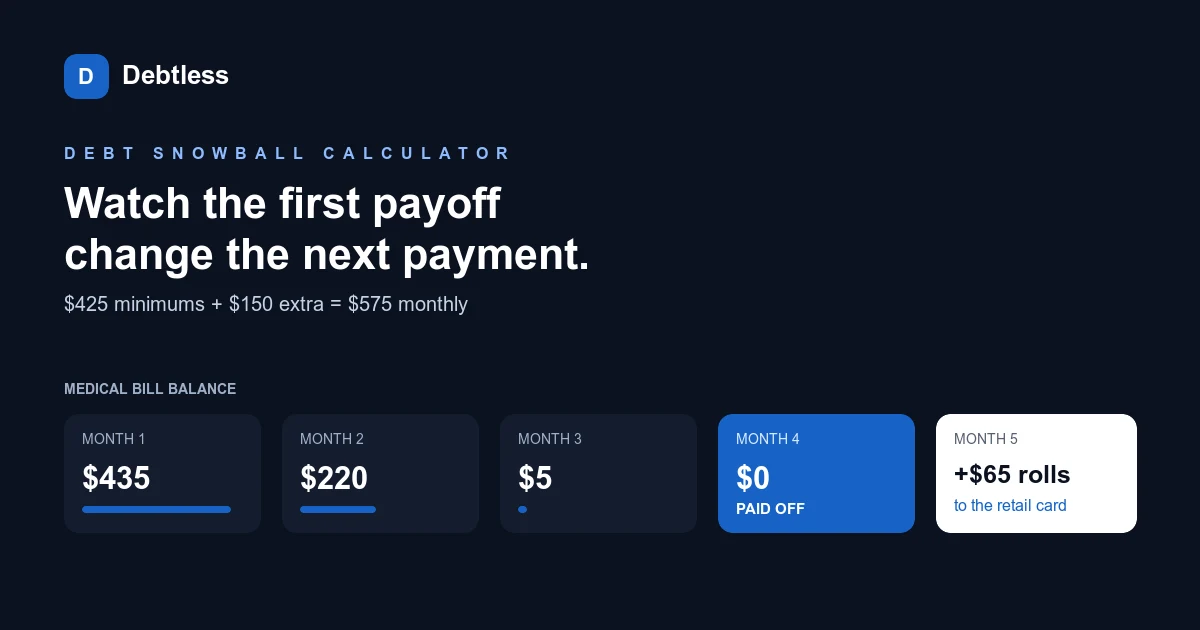
This debt snowball calculator example uses four balances totaling $15,200, required minimums totaling $425, and a $150 monthly extra. The planned debt budget is therefore $575. Each account keeps receiving its minimum while the extra is concentrated on the smallest active balance.
The smallest balance is a $650 medical bill at 0%, followed by a $1,850 retail card at 27.49%, a $4,900 student loan at 5.5%, and a $7,800 auto loan at 8.25%. Snowball order uses balance rather than APR, so the medical bill goes first even though the retail card costs more interest per dollar.
The CFPB says the snowball method puts extra funds toward the smallest debt while minimum payments continue on every debt. Its guidance also says the freed payment moves to the next-smallest balance after the first payoff. That rollover is the part a useful calculator must show, not merely mention.
| Debt | Starting balance | APR | Required minimum | Snowball position |
|---|---|---|---|---|
| Medical bill | $650 | 0% | $65 | 1 |
| Retail card | $1,850 | 27.49% | $60 | 2 |
| Student loan | $4,900 | 5.5% | $55 | 3 |
| Auto loan | $7,800 | 8.25% | $245 | 4 |
The $150 extra is separate from the $425 in minimums. The combined starting budget is $575 per month.
How does the smallest balance change in the first four months?
The smallest balance falls by $215 in each of the first three months because its $65 minimum and the $150 extra both go to the 0% medical bill. It ends month 1 at $435, month 2 at $220, and month 3 at $5. In month 4, only $5 is needed after the minimum step, so the remaining $145 of extra crosses to the retail card within the model.
Meanwhile, the other balances keep moving. They receive their minimums after interest is added under this simplified monthly calculation. The retail card ends month 1 at $1,832.38 even after a $60 payment because $42.38 of modeled interest accrued. The auto and student balances decline too, although neither receives the snowball extra yet.
The balance table does work that a payoff date cannot. It shows that every minimum was covered, the target changed at the right time, and no extra money disappeared during the final partial payment. If you want to try the same sequence with your figures, the Debtless payoff calculator uses this month-by-month rollover behavior.
| End of month | Medical bill | Retail card | Student loan | Auto loan |
|---|---|---|---|---|
| 1 | $435.00 | $1,832.38 | $4,867.46 | $7,608.63 |
| 2 | $220.00 | $1,814.36 | $4,834.77 | $7,415.93 |
| 3 | $5.00 | $1,795.92 | $4,801.93 | $7,221.92 |
| 4 | $0.00 | $1,627.06 | $4,768.94 | $7,026.57 |
| 5 | $0.00 | $1,389.34 | $4,735.79 | $6,829.88 |
Illustrative balances after monthly interest, required minimums, and the snowball extra. Actual posting dates and account calculations can differ.
What changes after the first snowball payoff?
The snowball payment grows by $65 after the medical bill is paid, so month 5 has $215 available above the active accounts' minimums. The retail card receives its own $60 minimum plus that $215 pool. Its modeled balance falls from $1,627.06 to $1,389.34 after monthly interest and payments.
The calculator continues the same rule after each payoff. The retail card clears in month 11, the student loan in month 25, and the auto loan in month 30. Payments accelerate because the available pool includes minimums from every balance that has already finished.
Researchers Keri Kettle, Remi Trudel, Simon Blanchard, and Gerald Häubl reported in the Journal of Consumer Research that the motivating effect of concentrated repayment was most pronounced when payments focused on the smallest accounts. They wrote that consumers infer progress from the "greatest proportional balance reduction" in one account. That behavioral finding does not erase the interest tradeoff, but it explains what the snowball is designed to make visible.
- Pay the current required minimum on every active balance.
- Send the $150 extra to the smallest balance.
- Use only the amount needed when that target reaches zero.
- Move any unused extra to the next-smallest balance in the same modeled month.
- Starting the next month, add the finished debt's $65 minimum to the snowball pool.
How does this snowball result compare with avalanche?
This snowball result and the avalanche both finish in 30 modeled months, but the snowball costs $163.62 more interest. Avalanche targets the 27.49% retail card first and produces $1,505.34 in estimated interest. Snowball produces $1,668.96 because it spends the first four months finishing the 0% bill.
The first milestone differs too. Snowball clears the medical bill in month 4. Under avalanche, the retail card and medical bill both reach zero in month 10 because the medical minimum keeps reducing that balance while extra money goes to the card. One method offers an earlier closed balance; the other saves modeled interest.
The snowball-versus-avalanche guide explains the decision without treating either rule as a moral test. If interest cost is the deciding measure, the debt avalanche calculator example shows how APR sorting works. Use the same $575 budget when comparing, or the result will mix strategy with a spending increase.
Worked example · illustrative numbers
What does the complete four-debt snowball calculate?
| Milestone | Modeled month | Payment freed after payoff |
|---|---|---|
| Medical bill reaches $0 | 4 | $65 |
| Retail card reaches $0 | 11 | $60 |
| Student loan reaches $0 | 25 | $55 |
| Auto loan reaches $0 | 30 | $245 |
| Plan total | 30 months | $1,668.96 interest; $16,868.96 paid |
The model assumes fixed APRs, no fees or new borrowing, monthly compounding, minimums paid before the extra, and smaller final payments.
Put this into practice with Debtless
Debtless can store the four debts in a manual, on-device ledger and compare snowball with avalanche under the same $575 monthly budget. The app does not connect to creditors or make payments, so update the balances from statements and confirm every real transaction with the account provider.

Common questions
Does a debt snowball calculator ignore interest?
No. Snowball chooses the focus debt by balance, but a useful calculator still adds interest to every applicable balance. The ordering rule and the interest calculation are separate parts of the model.
What happens if two debts have the same balance?
The calculator needs a stated tie-breaker. Debtless uses the higher APR when balances tie in snowball mode. Another tool may preserve the entered order, so inspect its rule before comparing results.
Why does the payment grow after a debt is paid?
The finished debt's old minimum becomes available for the next target while the overall monthly budget stays constant. In this example, the $150 extra becomes a $215 pool after the $65 medical payment is freed.
Can I include a car loan in a debt snowball?
You can model an auto loan, but keep making its required payment and review the loan terms before sending extra money. A calculator estimate does not change the lender's payment rules or the risk attached to secured debt.
Sources & further reading
- CFPB: How to reduce your debt
- Journal of Consumer Research: Repayment Concentration and Consumer Motivation to Get Out of Debt
General education for U.S. readers, not individualized financial, legal or tax advice. Examples are hypothetical; lender terms and actual interest calculations can differ. Check your current statements and agreements.
Published by Debtless with AI-assisted drafting. How this journal is made · Suggest a correction