 Debtless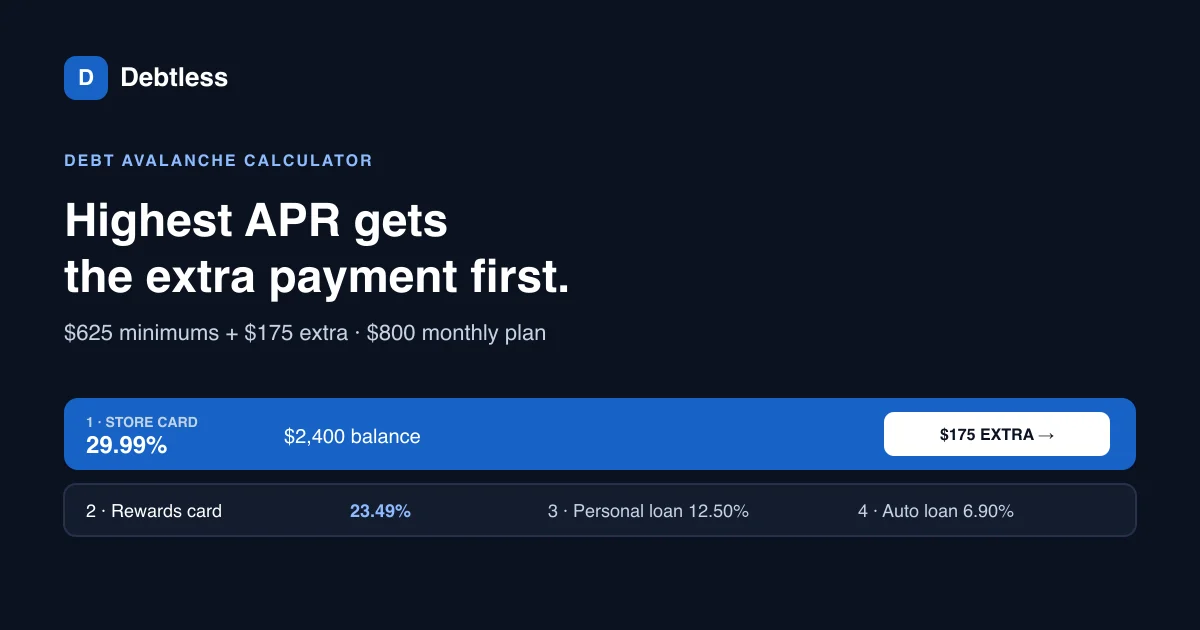
The short answer
A debt avalanche calculator pays every required minimum, then directs all extra money to the debt with the highest current interest rate. When that balance reaches zero, its old payment rolls into the debt with the next-highest rate. In the four-debt example below, a $175 monthly extra targets the 29.99% store card first and produces a 34-month modeled payoff.
How does a debt avalanche calculator choose the first debt?
A debt avalanche calculator chooses the first debt by sorting current APRs from highest to lowest. Balance size does not decide the order. The minimum payment does not decide it either. Those numbers affect the schedule, while the APR identifies where an extra dollar avoids the most future interest under the model.
According to the Consumer Financial Protection Bureau's Reducing Debt Worksheet, the highest-interest-rate method focuses on the unsecured debt with the highest rate because it costs the most, then moves to the next most expensive debt. The same CFPB worksheet describes the snowball as a separate rule that starts with the smallest amount owed. That distinction gives a calculator a clear sorting job before it estimates dates or interest.
Use the APR that applies now. A promotional rate, variable rate, or card with multiple balance categories may need more care than one number can show. If your statement lists separate purchase and cash-advance APRs, record them before choosing an order. The guide to starting an avalanche with verified rates explains how to build that source list without guessing.
What numbers belong in a debt avalanche calculator?
A debt avalanche calculator needs each current balance, APR, required minimum, and one monthly amount available above all minimums. Copy the figures from statements dated as close together as practical. A six-month-old balance paired with today's rate creates a clean-looking forecast from mismatched inputs.
Keep the extra amount separate from the minimums. In this example, minimums total $625 and the extra amount is $175, so the planned debt budget is $800 a month. Calling the full $800 an extra payment would count the minimums twice. Calling only the $175 the entire budget would make the plan fail to cover required payments.
The Debtless debt payoff calculator accepts those same fields and holds the monthly debt budget steady as balances finish. Before entering anything, check that the planned $800 still leaves room for housing, food, utilities, and other required bills. A mathematically fast schedule has little value if it depends on money that is already committed.
| Debt | Balance | APR | Minimum | Avalanche rank |
|---|---|---|---|---|
| Store card | $2,400 | 29.99% | $75 | 1 |
| Rewards card | $6,800 | 23.49% | $180 | 2 |
| Personal loan | $3,200 | 12.50% | $110 | 3 |
| Auto loan | $9,500 | 6.90% | $260 | 4 |
The rank follows APR, not balance or minimum payment. The $175 extra goes to rank 1 after every minimum is covered.
How does the extra payment move after one debt is paid?
The extra payment moves by combining the finished debt's old payment with the existing extra amount. At the start, the store card receives its $75 minimum plus the $175 extra, or $250 before any final-payment adjustment. The other three accounts continue receiving their required minimums.
The model finishes the store card in month 12. In the following month, its $75 minimum joins the $175 extra, making $250 available above the rewards card's own $180 minimum. The rewards card can then receive up to $430. When that card finishes, another $180 becomes available for the next active target.
Real statements will drift from a simplified monthly model. Credit cards often calculate interest from daily balances, payment posting dates differ, and minimums can change as balances fall. Treat the order as a decision rule and the date as an estimate. Re-enter current balances at a regular review point rather than forcing the account to match an old forecast.
- Pay at least the required minimum on every active debt.
- Send the $175 extra to the active debt with the highest APR.
- After a payoff posts, add that debt's old minimum to the extra-payment pool.
- Aim the larger pool at the next-highest APR and repeat.
- Reconcile the model with current statements before changing the next payment.
When do the debt avalanche and debt snowball give the same order?
Debt avalanche and debt snowball give the same order when balances rise in the same sequence that APRs fall. Put plainly, the smallest debt must also have the highest rate, the second-smallest must have the second-highest rate, and that pattern must continue through the list.
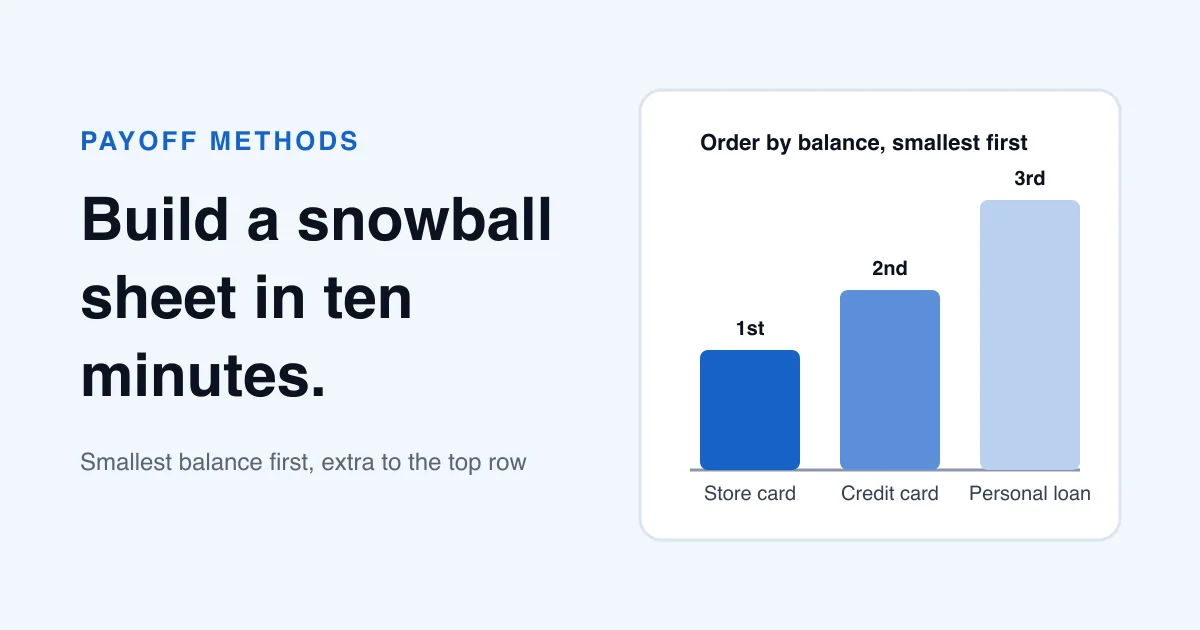
This example matches only at the first step. The $2,400 store card is both the smallest balance and the highest APR, so both methods target it first. They split after that: avalanche moves to the $6,800 rewards card at 23.49%, while snowball moves to the $3,200 personal loan at 12.50%.
The snowball-versus-avalanche guide compares the rules without changing the monthly budget. If two methods give the same full order, their modeled schedule will also match when all other assumptions stay fixed. If they diverge, the order and interest can differ even though the total monthly outlay starts at the same $800.
Worked example · illustrative numbers
What does the four-debt avalanche example calculate?
| Measure | Avalanche | Snowball with same $800 budget |
|---|---|---|
| First target | Store card, 29.99% | Store card, $2,400 |
| Second target | Rewards card, 23.49% | Personal loan, $3,200 |
| Modeled payoff time | 34 months | 35 months |
| Modeled interest | $4,731.52 | $5,420.56 |
| Difference | $689.04 less interest | One additional month |
Illustrative monthly model: $21,900 total starting balance, $625 in minimums, $175 extra, no new charges or fees, fixed APRs, and freed minimums rolled forward.
Put this into practice with Debtless
Debtless can keep the four balances in one local ledger and compare avalanche with snowball under the same monthly amount. If you prefer to enter accounts manually, the guide to tracking debt without bank linking describes what to record and what the app does not import. Verify every modeled payment against the creditor's current statement.

Common questions
Does a debt avalanche calculator include minimum payments?
Yes. A usable avalanche calculator pays each required minimum before assigning extra money to the highest-APR debt. Entering only the focus payment can make the schedule understate the monthly budget.
Should I rank debts by APR or by the monthly interest charge?
Rank a strict avalanche by APR. A large low-rate balance can show more interest dollars this month than a small high-rate balance, but that does not make its next extra dollar more valuable under the avalanche rule.
What happens when two debts have the same APR?
Use a consistent tie-breaker, such as the smaller balance first, and document it. Equal rates make the modeled interest effect of the first extra dollar equivalent when the other terms are comparable.
Can I include a mortgage or auto loan in the avalanche?
You can model them, but review secured-loan terms and immediate household risks before sending extra money. Required payments on every account still come before the avalanche extra.
Sources & further reading
General education for U.S. readers, not individualized financial, legal or tax advice. Examples are hypothetical; lender terms and actual interest calculations can differ. Check your current statements and agreements.
Published by Debtless with AI-assisted drafting. How this journal is made · Suggest a correction