 Debtless
Which account numbers start a debt payoff plan?
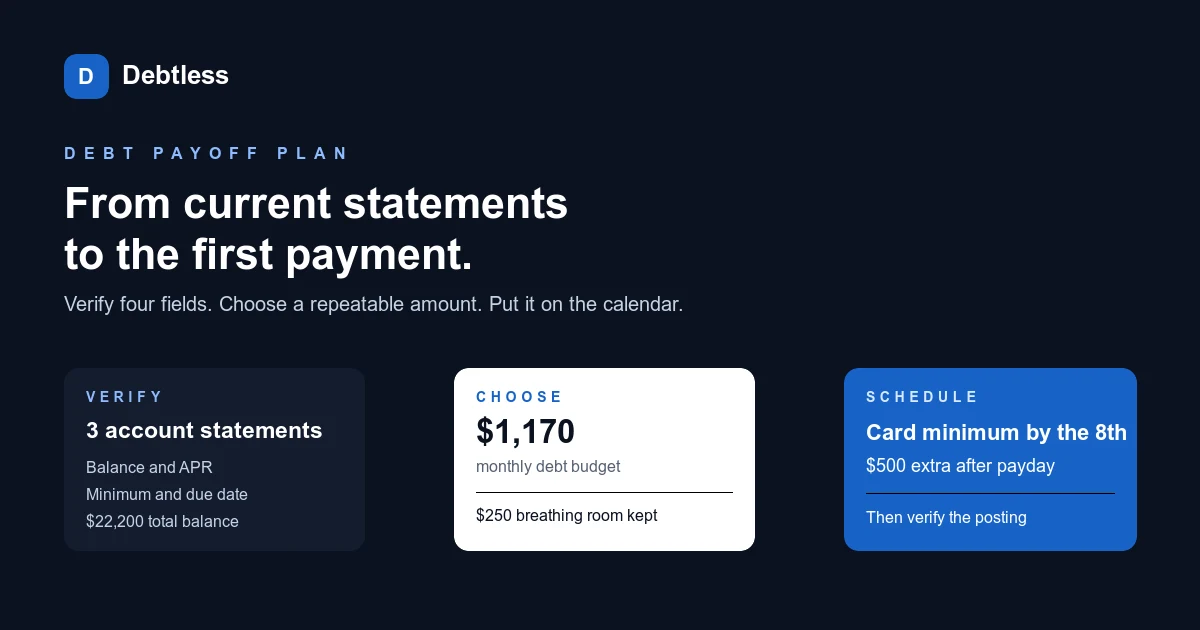
A debt payoff plan starts with four account numbers: the current balance, APR, required minimum, and payment due date. Pull them from statements covering the same general period and write down each statement date. This morning's online balance and last month's minimum can both be accurate, but they describe different snapshots.
The CFPB debt log says loan statements can supply monthly payment amounts, due dates, and interest rates. It also asks for the total amount left to pay. The tool's stated purpose is to "see a full picture of all your debt payments," which is the right first checkpoint before choosing what goes first.
List special terms beside the four numbers. Mark promotional-rate deadlines, variable rates, past-due amounts, secured loans, and accounts in collections. These details can change the priority even when a simple balance or APR sort looks clear. The longer statement-based debt payoff plan guide shows where to find each field without relying on memory.
| Debt | Balance | APR | Minimum | Due date |
|---|---|---|---|---|
| Credit card | $6,200 | 22.9% | $190 | 8th |
| Personal loan | $4,400 | 12.9% | $160 | 16th |
| Auto loan | $11,600 | 7.1% | $320 | 24th |
| Total | $22,200 | Not applicable | $670 | Three dates |
Illustrative snapshot. Confirm real amounts and dates from current creditor records.
How much monthly payment can the plan survive?
The monthly payment a debt payoff plan can survive is the amount left after essential expenses, near-term irregular costs, the reserve you choose to keep, and all required minimums. One unusually cheap month can produce a fragile maximum. Use recent actual spending and leave room for the next ordinary surprise.
In this example, $5,050 of take-home income minus $3,280 of essentials, $350 for irregular bills and reserves, and $670 of minimums leaves a theoretical $750 extra. The plan uses $500 extra and leaves $250 unassigned as breathing room. The recurring debt budget is $1,170, not the full $1,420 the best-case subtraction could support.
The CFPB prioritizing-bills tool warns that falling behind on secured debts can put a car or house at risk. It also recommends subtracting expenses such as rent, utilities, transportation, childcare, and groceries before deciding what is left for debts. If the subtraction is negative, pause the acceleration exercise and address the shortfall or contact creditors early.
| Monthly cash decision | Amount |
|---|---|
| Take-home income | $5,050 |
| Essential and ordinary expenses | -$3,280 |
| Irregular bills and chosen reserve | -$350 |
| Required debt minimums | -$670 |
| Theoretical extra | $750 |
| Repeatable extra selected | $500 |
| Breathing room left | $250 |
The plan commits $1,170 to debt: $670 of minimums plus a $500 extra.
Which payoff order should the plan use?
The payoff order should match one stated objective after urgent consequences and minimums are handled. Snowball puts the smallest balance first, avalanche puts the highest APR first, and a custom order can account for a documented deadline or risk. Pick one rule for the first review period so every extra payment has a destination.
This example uses avalanche, so the $500 extra goes to the 22.9% credit card. The $4,400 personal loan is smaller, but its 12.9% APR does not win the rate-based sort. Under the Debtless monthly model, the card reaches zero in month 10, the personal loan in month 14, and the auto loan in month 21, with $2,171.87 in estimated interest.
A do-it-yourself payoff plan does not replace a creditor program. The comparison of a debt management plan and consolidation loan explains two options that can change rates, terms, or who receives the payment. A normal payoff order changes where you direct available extra money; it does not renegotiate the underlying accounts.
- Keep every required minimum in the plan.
- Set aside the $500 extra only after the cash-flow check passes.
- Direct the extra to the 22.9% card under the chosen avalanche rule.
- After its payoff posts, roll the old $190 minimum into the next target.
- Recheck the order when an APR, deadline, or account status changes.
What belongs on the first payment calendar?
The first payment calendar should show the income dates funding the plan, each due date, each required minimum, and the planned extra payment date. A monthly total can fit while the checking account still runs short before payday. Timing turns the strategy into a payment routine.
Schedule the $190 card minimum by the 8th, the $160 personal-loan minimum by the 16th, and the $320 auto payment by the 24th. Place the $500 card extra after the paycheck and essential bills that fund it are available. The first month should be conservative enough to complete without moving groceries or utilities back onto a card.
Record three states: planned, submitted, and posted. A calendar entry proves only intent. Save the confirmation, then check that the creditor applied the payment as expected. If you later receive a bonus or refund, model it separately; the guide to adding a windfall to a debt payoff plan keeps a one-time payment from silently inflating the recurring budget.
How do you update the plan without starting over?
You update a debt payoff plan by saving a new dated snapshot and carrying forward what actually happened. Replace balances with verified statement figures, revise changed APRs or minimums, and explain any gap caused by interest, fees, purchases, credits, or a different payment. Keep the old snapshot so progress does not vanish when the forecast moves.
Review the plan monthly at first. A rate change or new balance can change an avalanche order, while a lower balance can change a snowball order. If cash flow tightens, lower the $500 extra instead of pretending the old figure still fits. The payments already made still count.
If a new loan is being considered, compare it with the current plan from today's balances rather than the original starting point. Debt consolidation versus a payoff plan separates a new borrowing decision from simply reorganizing existing payments. Keep the current plan usable until a replacement is approved, understood, and actually in effect.
Worked example · illustrative numbers
What does the example debt payoff plan produce?
| Extra above minimums | Monthly debt budget | Modeled payoff | Modeled interest |
|---|---|---|---|
| $0 | $670 | 42 months | $5,651.10 |
| $250 | $920 | 28 months | $3,019.96 |
| $500 selected | $1,170 | 21 months | $2,171.87 |
| $750 theoretical max | $1,420 | 17 months | $1,727.69 |
Illustrative avalanche model for $22,200 across three fixed-APR debts, with no new borrowing or fees. The $500 plan keeps $250 of monthly breathing room instead of committing the theoretical maximum.
Put this into practice with Debtless
Debtless gives this plan a manual, on-device home for balances, rates, minimums, due dates, and payoff comparisons. It does not link a bank account or send money. Start with the statement and budget, make the payment through the creditor, then confirm the posting and update the snapshot.

Common questions
What should I do first in a debt payoff plan?
Create one dated list of balances, APRs, required minimums, and due dates. Check urgent consequences and whether the minimums fit before choosing where any extra payment goes.
How much extra should a debt payoff plan use?
Use an amount left after necessary expenses, minimums, near-term irregular bills, and the reserve you decide to keep. In the example, $750 is theoretically available, but the repeatable extra is $500.
Should a mortgage be in the same debt payoff plan?
It can be listed for a complete picture, but many people compare shorter consumer debts separately because a mortgage has a longer term, different risks, and its own servicing rules. Keep its required payment protected either way.
Is a debt payoff plan the same as debt consolidation?
No. A payoff plan organizes payments on existing accounts. Consolidation generally creates a new loan or transfer that changes the account structure, rate, fees, or term. Compare total cost and conditions before replacing the current plan.
When should I change my debt payoff plan?
Change it when verified balances, APRs, minimums, due dates, income, expenses, or account risks materially change. Save the old snapshot and document the reason so the update is understandable.
Sources & further reading
General education for U.S. readers, not individualized financial, legal or tax advice. Examples are hypothetical; lender terms and actual interest calculations can differ. Check your current statements and agreements.
Published by Debtless with AI-assisted drafting. How this journal is made · Suggest a correction