 Debtless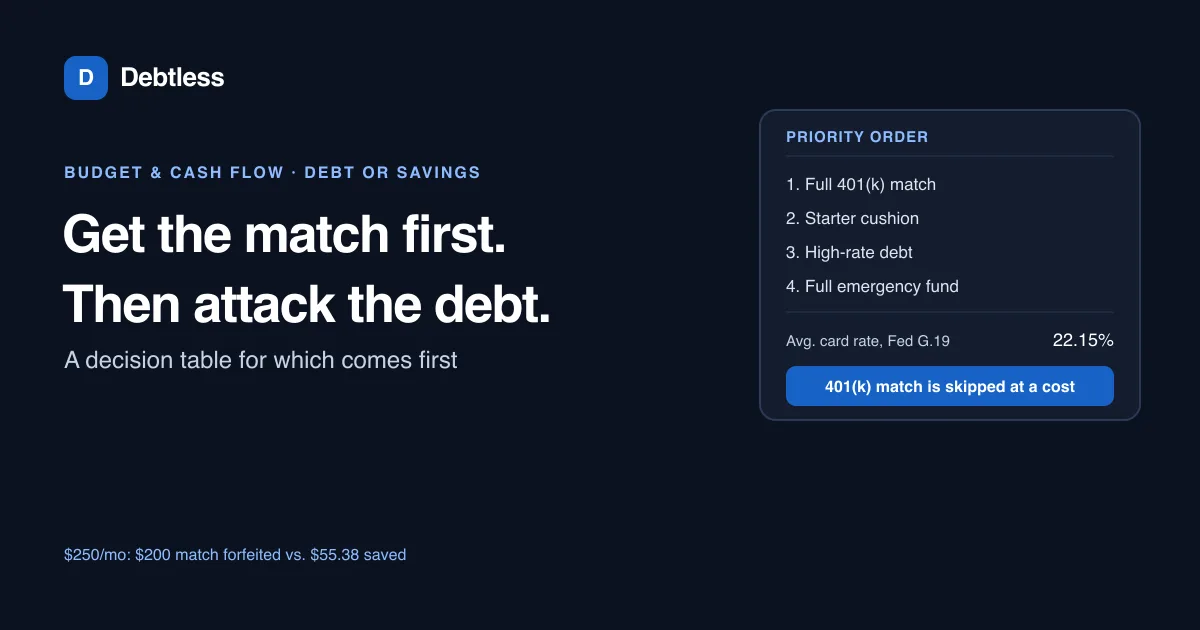
The short answer
Pay off high-rate debt first in most cases, but capture a full employer 401(k) match before sending extra money to a credit card, since the match is free money with no real downside risk. Build a small starter cushion of a few hundred dollars before either one if you have no savings at all and a track record of borrowing on a card for surprise expenses. Past those two exceptions, a credit card averaging 22.15% interest, according to the Federal Reserve, costs more than almost any guaranteed alternative, which is why debt payoff comes first once the match is captured and a thin buffer exists.
Why does the employer match change the order?
An employer 401(k) match is money added to your account on top of what you contribute, and it usually takes a specific contribution percentage to get the full amount. Fidelity's data on its administered plans shows the most common formula matching dollar-for-dollar on the first 3% of pay and 50 cents on the dollar on the next 2%, so an employee contributing 5% receives a 4% employer match on top.
Skipping that contribution to send extra money toward debt instead costs more than a delay. In many plans, a missed pay period's match is gone for good, since not every plan offers a year-end true-up for contributions you didn't make. That's why the common advice is to capture the match first even while carrying debt, then direct any additional extra money to payoff, a sequencing echoed by financial planners interviewed by the Center for Retirement Research at Boston College.
When does paying off the debt still come first?
If no employer match is on the table, or a 401(k) isn't available at all, the comparison is simpler: the interest rate on your debt against a return you'd have to count on, not hope for. The average credit card rate on balances charged interest sat at 22.15% in the second quarter of 2026, according to the Federal Reserve, a rate almost no savings account or guaranteed investment matches.
A rate that high turns debt payoff into the better-than-guaranteed option, since every dollar applied to the balance is a dollar that stops owing 22.15% for good. A mortgage or federal student loan sitting at 5% to 7% doesn't carry the same urgency; by comparison, a balance in the same size range can realistically be cleared far sooner, as How long does it take to pay off $10,000 in debt? lays out across different monthly budgets.
How much of an emergency fund do you need before focusing on debt?
You don't need the full three-to-six-month cushion financial planners eventually recommend before you start on debt. A starter buffer of a few hundred dollars, enough to cover a car repair or a smaller medical bill without reaching for the card again, is usually enough to begin aggressive payoff without undoing your own progress on the next surprise expense.
Should you keep an emergency buffer while paying off debt? covers how to size that starter amount against your specific risks, since a household with one income and irregular hours needs a different number than one with two steady paychecks.
What if a windfall or bonus shows up while you're deciding?
A tax refund, bonus or other lump sum doesn't have to go entirely to one side. A common split sends a starter amount to savings if that buffer doesn't exist yet, the employer-match percentage if a paycheck's worth was missed, and the rest to the highest-rate debt carried.
How to allocate a work bonus while paying off debt walks through doing that math off the actual take-home deposit rather than the number printed on the offer letter, since taxes and withholding shrink a bonus before it ever reaches an account.
Which comes first: debt or saving?
| Situation | Priority |
|---|---|
| Employer 401(k) match available and not fully captured | Contribute enough to get the full match, then send extra cash to debt |
| No emergency fund at all, carrying high-rate debt | Build a small starter cushion first, then attack the debt |
| High-rate debt (credit cards, most personal loans), match already captured | Debt payoff; the guaranteed rate beats most alternatives |
| Low-rate debt only (a mortgage, a federal student loan under about 7%), no match available | Save or invest; the debt isn't urgent enough to outrank it |
| Emergency fund funded and match captured, debt still outstanding | Aggressive payoff; build a plan around your specific balances and rates |
Match formula per Fidelity's data on administered 401(k) plans; card rate per the Federal Reserve's G.19 release.
Worked example · illustrative numbers
Example: a $250-a-month decision
Take a hypothetical salary of $60,000 a year, $5,000 a month before taxes, with a 401(k) plan that matches dollar-for-dollar on the first 3% contributed and 50 cents on the dollar on the next 2%. Contributing 5%, or $250 a month, draws a $200 employer match on top, the formula Fidelity describes as the most common across its administered plans.
Skip that $250 contribution for a month to put it toward a $3,000 credit card balance at the Federal Reserve's reported 22.15% average instead, and the move saves $55.38 in interest that month. It also forfeits $200 in employer money outright, a net loss of $144.62 compared with making the contribution and finding the extra payment somewhere else in the budget.
Put this into practice with Debtless
Debtless tracks exactly how long a given monthly amount takes to clear a balance, so you can see what redirecting $250 actually buys in months saved before deciding whether it's worth skipping a 401(k) contribution to do it, right inside the free iPhone app's payoff calculator.

Common questions
Should I stop my 401(k) contributions to pay off credit card debt faster?
Not if it means giving up an employer match. The match is money added on top of your own contribution with no market risk attached to getting it, which almost always outweighs the interest saved by skipping it for a month or two.
How much should I have in savings before focusing on debt?
A few hundred dollars is usually enough to start. That starter amount covers a typical surprise expense without sending you back to a credit card, and the fuller three-to-six-month cushion can wait until after high-rate debt is handled.
Is it ever right to pay off debt before saving anything at all?
Yes, if the debt carries a very high rate and there's no employer match on the table. In that case, every dollar toward the balance stops a cost that's higher than almost any return you could count on from saving instead.
Does the type of debt change the answer?
Yes. A credit card averaging 22.15% interest behaves very differently from a mortgage or federal student loan in the 5% to 7% range. The high-rate debt usually outranks saving; the low-rate debt usually doesn't.
Sources & further reading
- Federal Reserve: Consumer Credit G.19, credit card interest rates
- Fidelity: How does a 401(k) match work?
- Center for Retirement Research at Boston College: How to Set Your Savings Priorities
General education for U.S. readers, not individualized financial, legal or tax advice. Examples are hypothetical; lender terms and actual interest calculations can differ. Check your current statements and agreements.
Published by Debtless with AI-assisted drafting. How this journal is made · Suggest a correction