 Debtless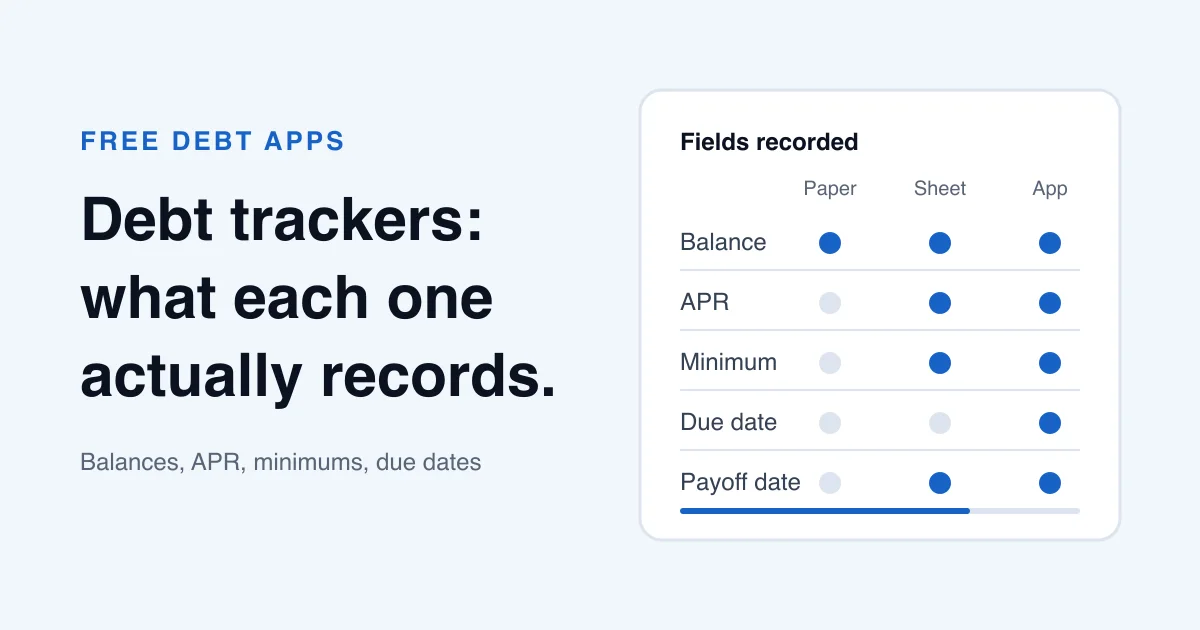
The short answer
A debt-free tracker is any record that shows what you owe on each debt and when the last payment should land. Paper, a spreadsheet and a free debt app can all do that, but they differ in what they record for you: a paper sheet holds only what you write, a spreadsheet holds what you build, and an app stores the fields a payoff date depends on. Those fields are the balance, APR, minimum payment, due date and the extra amount you can send each month.
What does a debt-free tracker need to record?
A tracker can only project a payoff date if it knows the balance and APR of each debt, the minimum you must pay, the day that payment is due, and how much you can send beyond the minimums. The balance is the starting point. The APR sets how much interest lands on that balance each month. The minimum is the floor, and the due date tells you when the next one is owed. The extra amount sets how quickly the balance falls.
APR is the field that homemade trackers get wrong most often, because card interest does not arrive as one fixed charge each month. The Consumer Financial Protection Bureau says that "many credit card companies calculate the interest you owe daily, based on your average daily account balance." A monthly estimate of balance times APR, divided by 12, is good enough for planning. Your statement still has the final number.
| Field | Paper worksheet | Spreadsheet you build | Debtless, the free iPhone app |
|---|---|---|---|
| Balance | Written by hand each time | One cell per debt, updated by you | Entered for each debt, then updated as you record payments |
| APR | Written by hand, no interest math | A column, plus a formula for interest | Entered for each debt, and used to compute interest |
| Minimum payment | Written by hand | A column | Entered for each debt |
| Due date | Written by hand, no reminder | Only if you add a date column | Entered for each debt |
| Extra monthly payment | A note in the margin | One cell you change | A slider on the Plan tab |
| Payoff date | Only by hand calculation | Only if you write the formulas | Projected from the entries above |
The paper and spreadsheet columns describe what you would have to write or build. The app column describes its entry fields and the Plan tab.
How does a paper worksheet hold up over a year?
A paper worksheet is the simplest tracker, and it shows only what you wrote. It does no arithmetic, so every update means working out the new balance yourself. Skip a month and the sheet keeps the old number, with nothing on the page to flag it as stale. Paper works best for a short plan with two or three debts that you update on the same day each month.
When does a spreadsheet earn its keep?
A spreadsheet is the most flexible option. You choose the columns, you can split a card with two APRs into two rows, and you can model a lump sum next to a steady extra payment. The cost is that you own every formula. Interest, rollover and the payoff date are only as correct as the cells that compute them, and a range that stops one row short will quietly drop a debt from the total. If you are weighing that upkeep against an app, Free debt app or spreadsheet: choose by the work involved lays out the maintenance side.
What does a debt app record that the other two leave out?
An app keeps the same fields in a fixed structure, so the projection comes from the same inputs every time. Debtless stores the balance, APR, minimum payment and due date for each debt, records payments, and shows total debt, percent paid off and a projected debt-free date. You can type each debt in or scan a statement with the camera, and you review the fields before anything saves.
The app has no bank linking and no account, so the balances on screen are the ones you entered. It does not pay creditors, confirm a balance with them or pull a credit report. Its projected date is an estimate built from what you typed, so a balance that is $200 off moves the date as well. Before you commit to any free app, check what it requires and what it charges for.
What does a balance-only projection miss?
A balance-only projection is the quickest one to build. Total what you owe, divide by what you pay each month, and read the answer as a date. It also understates the time, because it leaves out the interest that keeps accruing while you pay. On the three-debt example below, dividing $10,200 by $515 gives 19.8 months, while a month-by-month projection gives 22 months and $1,118.91 in interest.
The gap is small on that example, but it widens with larger balances and higher rates. For scale, the Federal Reserve Board says in its G.19 consumer credit release dated September 8, 2026, that the rate on credit card accounts assessed interest was 22.15% in the second quarter of 2026. The 24% card in the example sits above that average, so its interest will run faster than a typical card.
| Projection method | Months to debt-free | Interest paid |
|---|---|---|
| Balance divided by monthly payment | 19.8 | Not counted |
| Month by month, interest added at APR divided by 12 | 22 | $1,118.91 |
Both rows use the same $515 monthly payment and the same three debts.
Worked example · illustrative numbers
Example: three debts, $515 a month, debt-free in 22 months
These three debts are hypothetical. A store card owes $3,000 at 24% APR with a $90 minimum. A second card owes $1,200 at 18% with a $45 minimum. A car loan owes $6,000 at 7% with a $180 minimum. You pay $515 a month: the $315 in minimums plus $200 of extra money, which goes to the highest APR debt first.
In month one, the store card accrues $60 of interest ($3,000 times 24, divided by 1,200). The $90 minimum and the $200 extra bring it to $2,770. The second card accrues $18 and ends the month at $1,173 after its $45 minimum. The car loan accrues $35 and ends at $5,855 after its $180 minimum. Month two starts from those balances, and the same steps repeat until the last balance reaches zero in month 22.
A tracker that records all four fields catches this. A tracker that records only balances does not, and its date arrives about two months early.
Put this into practice with Debtless
Debtless is a free iPhone app with no subscription, ads, account or bank linking. You enter each debt's balance, APR, minimum payment and due date, record payments, and see a projected debt-free date that moves when you change the extra payment on the Plan tab. It does not pay creditors or confirm balances with them, so keep your latest statements as the source of truth.

Common questions
Is a debt tracker the same as a debt payoff plan?
Not quite. A tracker records what you owe and what you have paid. A payoff plan uses those records to choose an order and a monthly amount. Many free apps and spreadsheets do both, but you can keep a tracker without ever building a plan.
Can a paper worksheet give an accurate payoff date?
Yes, if you do the interest math by hand every month: multiply each balance by its APR, divide by 12, add that to the balance, then subtract the payment. It works, but it takes time, and the date drifts quickly when a month gets skipped.
Do I need to connect my bank account to track debt?
No. Debtless has no bank connection and no account. You enter balances by hand or scan a statement. Some other trackers pull balances from your bank, so check how any tracker gets its numbers before you rely on it.
Why did my projected date jump after one month?
Compare the tracker balance with your latest statement first. A new charge, a late payment or an APR change can each move the date, and a tracker is only as current as its last entry.
Sources & further reading
General education for U.S. readers, not individualized financial, legal or tax advice. Examples are hypothetical; lender terms and actual interest calculations can differ. Check your current statements and agreements.
Published by Debtless with AI-assisted drafting. How this journal is made · Suggest a correction