 Debtless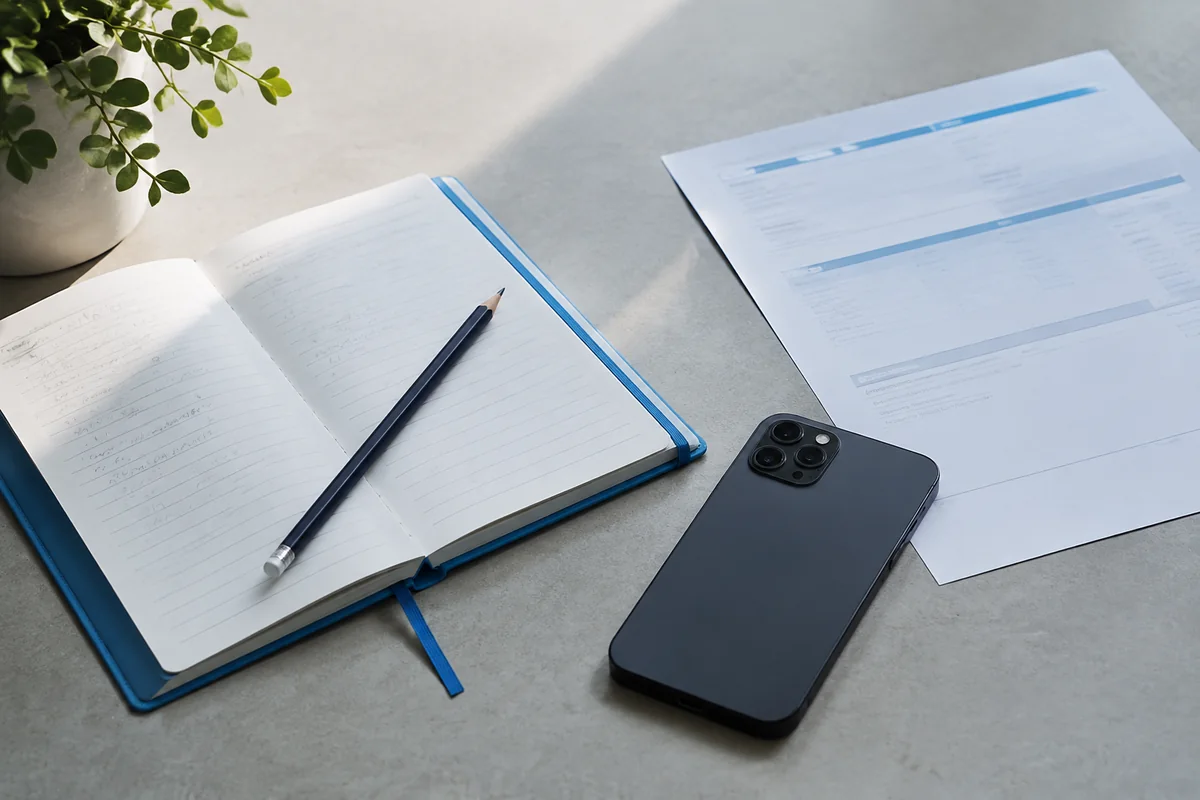
The short answer
Paper works well for a single debt or a simple running total, and writing numbers by hand can make the plan feel more real. It starts to strain once you're comparing payoff orders across several debts, since recalculating a full projection by hand every time a payment changes is slow and easy to get wrong. An app or spreadsheet takes over well at that point.
Where paper genuinely holds up
A single notebook page tracking one credit card, balance at the top, a row for each payment, works fine. Some people find that writing a number down by hand makes progress feel more concrete than watching a bar shrink on a screen. For one or two debts with simple minimum payments, paper isn't missing much.
Where paper starts to strain
The trouble starts with more than a couple of debts or any interest math beyond simple addition. Comparing what happens if you pay off the smallest balance first versus the highest rate first means running two full projections by hand, and redoing both every time your extra payment amount changes. That's a lot of arithmetic to keep accurate over months.
What a projection actually requires
A payoff date projection needs monthly interest calculated for every debt, a rollover rule for freed-up minimums, and a running total across however many debts you have, repeated for as many months as it takes. That's mechanical work a spreadsheet or app does instantly and paper does slowly, with more room for a dropped decimal or a skipped month.
A reasonable way to combine both
You don't have to pick one exclusively.
- Keep a simple paper log of payments made and dates, if that record-keeping feels motivating.
- Use an app or spreadsheet for anything involving interest projections or comparing payoff orders.
- Cross-check the two occasionally: your paper log's running total should match the app's current balance.
- If paper and the app disagree, trust the more recent statement, not either tool, to resolve it.
- Drop the paper log if it starts feeling like double the work rather than added motivation.
Worked example · illustrative numbers
Example: one month of interest, worked by hand
Say a paper ledger tracks a $1,900 balance at 23% APR. This month's interest, calculated by hand, is $1,900 times 0.23 divided by 12, which comes to $36.42. With a $100 payment, the new balance is $1,900 plus $36.42 minus $100, or $1,836.42.
That single calculation is manageable on paper. Doing the same thing for four debts, then comparing two different payoff orders across all four, each month, for the next two years, is where most people find paper stops being the faster option.
Put this into practice with Debtless
Debtless can replace the projection side of a paper ledger: enter each debt once and the Plan tab runs the interest and rollover math for Avalanche, Snowball, Cash Flow, and Custom order. Nothing stops you from also keeping a paper note of payments if that helps you stick with it.

Common questions
Does writing debt numbers by hand actually help motivation?
Some people find it does, since it slows down and makes the number feel concrete rather than an abstract figure on a screen. Others find a visual chart in an app more motivating. Neither is objectively better.
Can I keep a paper log alongside an app?
Yes, plenty of people do, using paper for a quick daily or weekly note and the app for the actual projections and payoff order comparison.
What's the biggest risk of doing payoff math on paper?
A small arithmetic error compounding over months without anyone catching it, since there's no formula checking the work behind a handwritten number.
Is a spreadsheet basically the same as paper, just faster?
It's a middle ground: still your own formulas and your own responsibility to get them right, but the calculation itself happens instantly instead of by hand.
Sources & further reading
General education for U.S. readers, not individualized financial, legal or tax advice. Examples are hypothetical; lender terms and actual interest calculations can differ. Check your current statements and agreements.
Published by Debtless with AI-assisted drafting. How this journal is made · Suggest a correction